PET: why this polyester became the material of bottles
A water bottle, a syrup bottle, a clear cream jar: the same plastic, PET, sits behind very different objects. It owes its place to a rare balance of clarity, strength and lightness.
By Tecmom editorial team · 2 min read
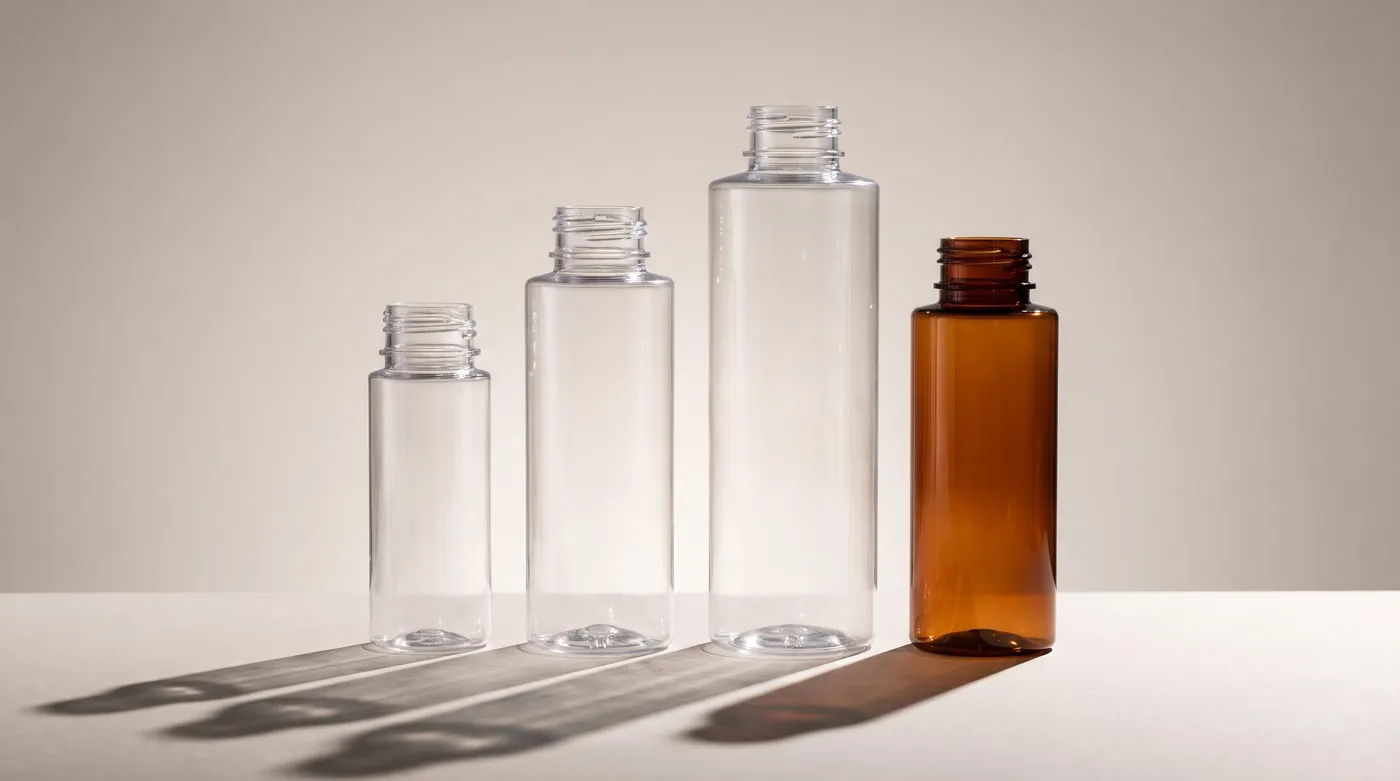
A polyester before it is a bottle
PET, or polyethylene terephthalate, is a polyester. It is made by reacting terephthalic acid with ethylene glycol. Patented in Britain in 1941, it was first used for textile fibres, then films; the PET bottle only appeared in the early 1970s.
Its resin identification code is 1. It melts at around 250 °C and softens much earlier, at around 70 to 80 °C: its glass transition sets the limit for what can be filled hot.
Clear or milky, depending on cooling
PET can be amorphous or crystalline. Cooled quickly, it stays amorphous and as clear as glass. Heated and cooled slowly, it crystallises and turns milky white. The process plays with this property: the preform is injected and then cooled fast so that it stays clear.
During blowing, the wall is stretched in two directions at once. This biaxial orientation aligns the polymer chains: it makes the bottle stronger and improves its gas barrier. See our article on the PET preform.
An honest barrier, not an absolute one
PET lets through far less oxygen and carbon dioxide than polyethylene or polypropylene, but it is not as tight as glass. For light-sensitive products it is tinted amber, which filters ultraviolet; see amber bottles.
It is also hygroscopic: the pellets absorb moisture from the air and must be dried before processing. Without drying, heat breaks the polymer chains and the wall loses strength.
Where it is found in packaging
Syrup bottles, oral solutions, cosmetics, food bottles: PET is the material of clear, rigid containers. It is also the best-recycled plastic, to the point that part of the material goes back into bottles; see recycled PET.
In the Tecmom catalogue, PET bottles range from 20 to 500 ml, including amber versions of 150 and 300 ml with a 28 neck finish.
PET did not beat glass on tightness. It beat it on everything else: weight, breakage, freedom of shape. For a bottle, that is often enough.
Glossary
- PET
- Polyethylene terephthalate, a thermoplastic polyester, resin code 1.
- Glass transition
- The temperature above which an amorphous plastic goes from rigid to rubbery.
- Biaxial orientation
- Stretching of the wall in two directions during blowing, which strengthens the bottle.
- Hygroscopic
- Absorbing moisture from the air.