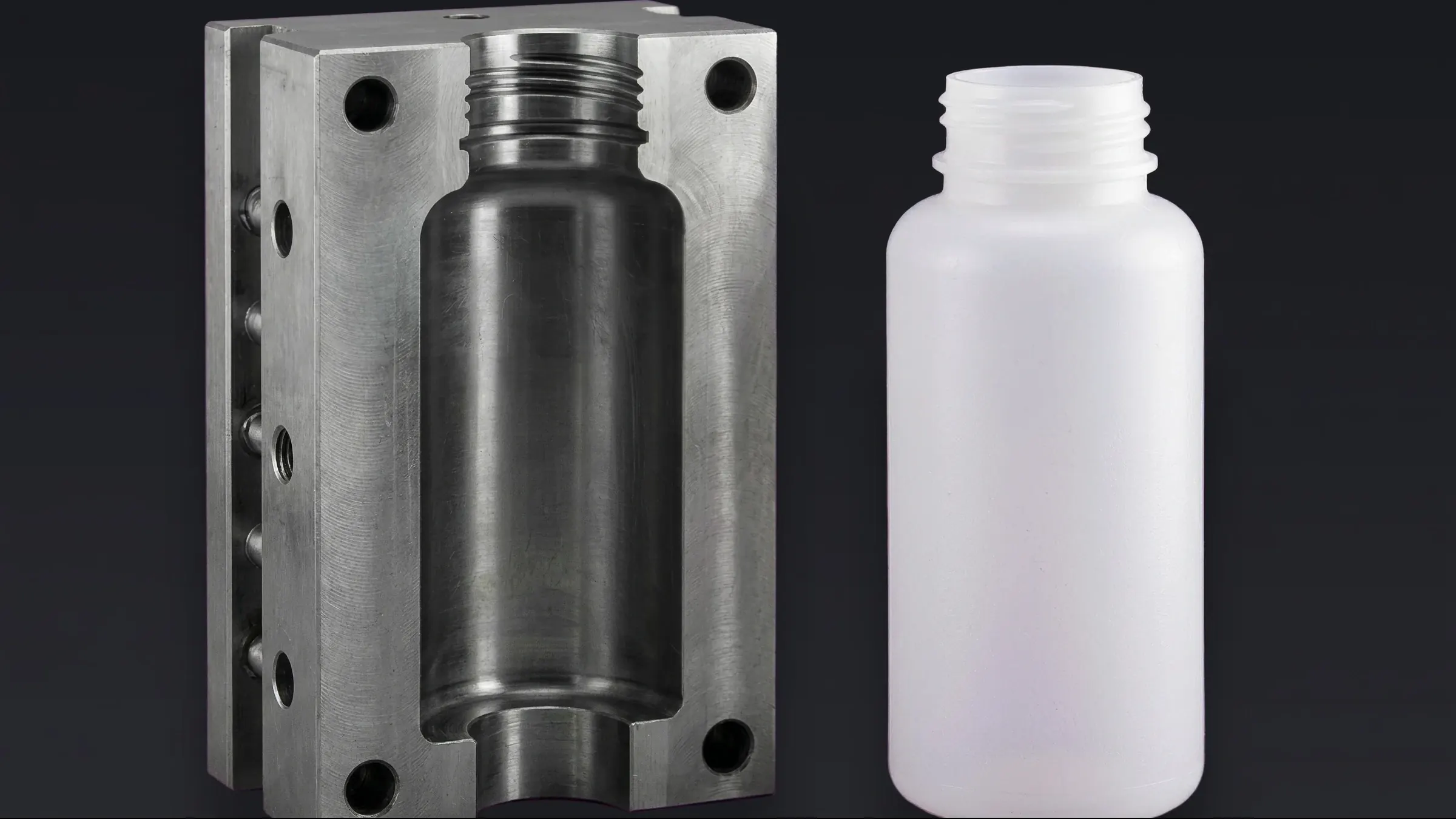
Our workshops are modern and equipped with the latest generation of computer-controlled machines. This means new products can be designed, built and fine-tuned in particularly short lead times.
Our processes
Packaging cannot be designed apart from the process that forms it: the process sets the geometry you can reach, the precision you get, and the quantity from which the tooling pays for itself.
Injection molding
Molten material is forced under pressure into a closed mold, where it solidifies before the mold opens. The process reproduces the cavity faithfully, down to its finest details: a thread, a hinge, a tamper-evident band come out of the mold finished, with no rework. It suits solid parts and closed shapes made in one piece — caps, closures, pill containers. Its precision is paid for in tooling: the mold concentrates most of the cost and the fine-tuning, and volume is needed to amortize it.
Injection blow molding
The material is first injected into a mold to form a preform: a thick blank that already carries the neck and its final thread. Still hot, the preform moves to a second mold where compressed air presses it against the walls and gives it its shape. The neck itself is never blown — its dimensions remain those of injection molding. That is what lets a bottle take a cap molded separately, on another machine, and close properly. The body comes out with no weld line and no material offcut.
Multi-layer extrusion
The material is pushed continuously through a die that gives it its profile. Several extruders can feed the same die: the layers then stack within the wall thickness, each bringing what the others lack — mechanical strength for one, an oxygen or moisture barrier for another, contact suitability for the inner layer. This is the process behind flexible tubes, where the thickness of a single layer decides how long the product keeps.
Mould design and manufacture
The company's name says it — Technologies Moules et Matrices: tooling is a trade here, not something bought in. Designing a mold means deciding in advance how the material will shrink as it cools, where the parting line runs, where the gates sit and how the cooling circuit is laid out — none of these choices can be corrected afterwards without cutting the steel again. It is also what makes it possible to produce a part that appears in no catalogue yet.
See the references these processes produce
Tecmom offers a wide range of packaging, caps and accessories, with maximum flexibility, value and service. And when they do not exist yet, we create them.