Recycled PET: what medicine packaging can accept
PET can be recycled, and EU law even allows it back into contact with food. So could a syrup bottle be made of recycled PET? The answer is not technical first: it is regulatory, and it is not the same for a fruit juice and for a medicine.
By Tecmom editorial team · 3 min read
Recyclable is not recycled
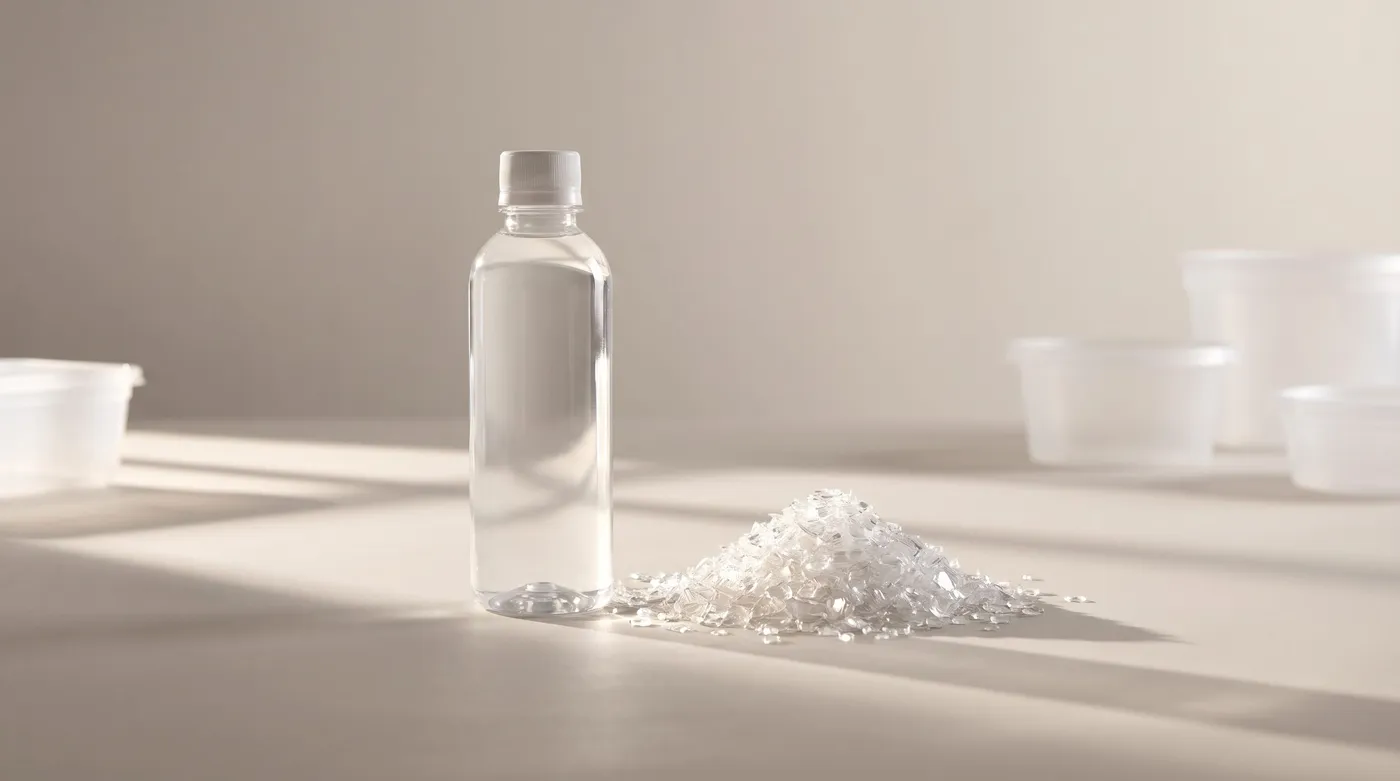
Two questions often get mixed up. A recyclable pack can, after use, be collected and turned into new material. A recycled pack is made, in whole or in part, of material from used packaging. PET and HDPE are recyclable; the real difficulty starts when recycled material is to go back into contact with a sensitive product.
Recycled material has a past. It may have held something other than food, been stored anywhere, mixed with other plastics. The question then becomes: what could migrate from it into the new contents?
In contact with food: decontaminate, then prove
In the European Union, Regulation (EU) 2022/1616 governs recycled plastic intended for food contact. It accepts only technologies deemed suitable: mainly mechanical recycling of post-consumer PET, where each process must be authorised after an opinion from the European Food Safety Authority, and recycling within a closed, controlled loop. At the heart of the system is a decontamination step.
Above all, the recycled material must meet the same requirements as virgin material, those of Regulation (EU) No 10/2011 on plastics in contact with food. Recycled plastic gets no special treatment.
Targets set for 2030
Regulation (EU) 2025/40 on packaging sets minimum recycled content for plastic packaging from 2030: notably 30% for so-called contact-sensitive PET packaging, such as food packaging, and 10% for other contact-sensitive plastic packaging.
But it provides exemptions. According to the text and its commentators, these targets do not apply to the immediate packaging of medicinal products, nor to certain medical devices. A medicine's outer packaging is not covered by that exemption in the same way.
Medicines, a separate case
The primary packaging of a medicine does not follow food contact rules. Its material is described and studied in the medicine's marketing authorisation file: composition, additives, exchanges with the contents. Any change must be justified to the authority. See primary packaging.
For a syrup bottle, the recycled-content question is therefore not settled in purchasing: it is settled in the laboratory's regulatory affairs department, medicine by medicine.
What it means for a buyer
For food or cosmetic packaging, the question to ask a supplier is precise: which recycling process does the material come from, and on what basis is it declared suitable for contact? For a medicine, the material must remain the one in the file. In both cases, the pack's recyclability after use is a separate argument, to be dealt with on its own.
See also HDPE, PET, PP and food packaging.
Recycled PET is neither banned nor ordinary. In contact with food, it must prove it is as good as virgin. In contact with a medicine, it must first find its way into a file. Between the two, the same bottle does not have the same status.
Glossary
- Recyclable
- Able to be collected and turned back into material after use.
- Recycled
- Made, in whole or in part, of material from used packaging.
- Decontamination
- The recycling step that removes substances likely to migrate.
- Migration
- Transfer of substances from the packaging into the product it holds.