Amber bottles: what they filter, and what they don't
The amber colour of a syrup bottle is not a matter of taste. It filters a precise part of the light, the part that degrades some active substances. But that is all it does, and it takes a measurement, not a colour, to tell whether it is enough.
By Tecmom editorial team · 2 min read
Light as a reagent
Some active substances are photosensitive: light supplies the energy for a reaction that degrades them. The trouble mostly comes from short wavelengths, ultraviolet and blue, the most energetic ones.
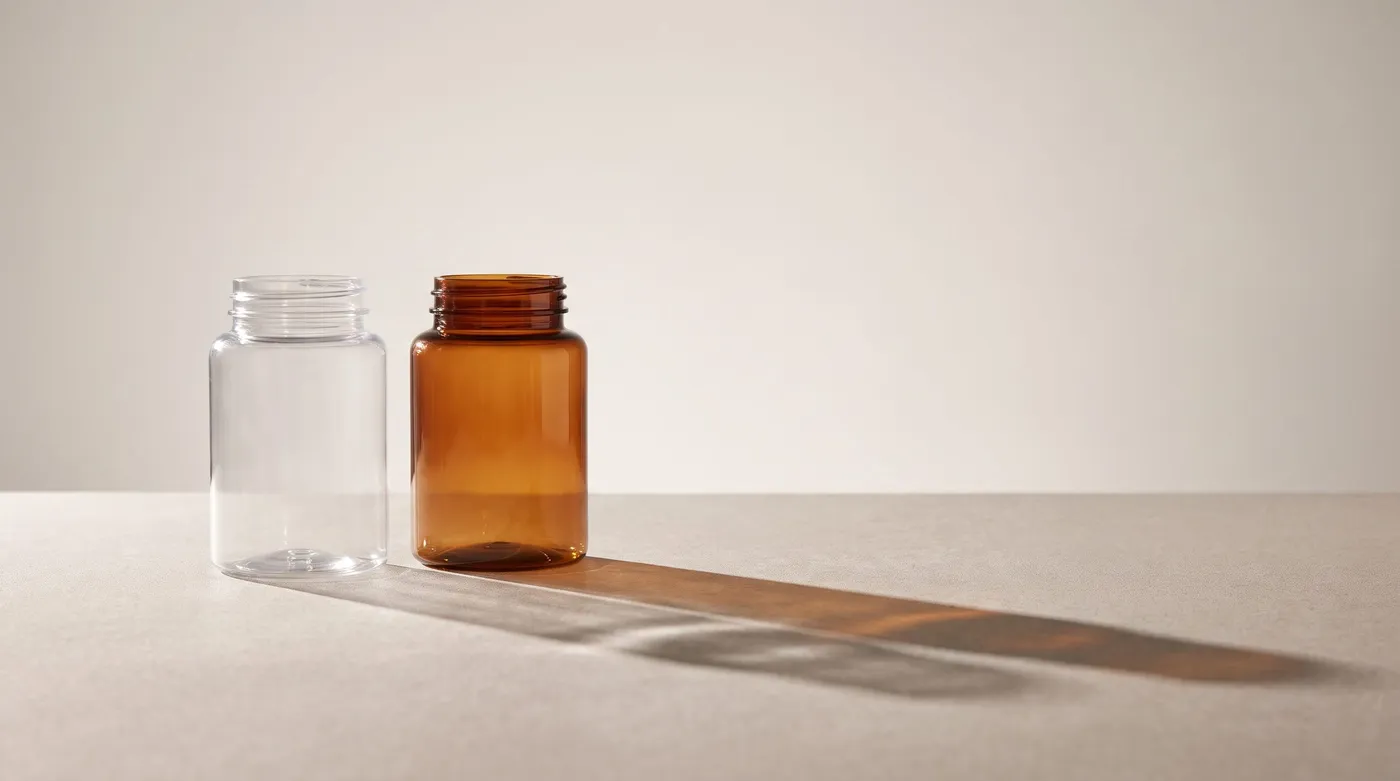
A clear bottle lets almost everything through. An amber bottle absorbs precisely those short wavelengths; it lets yellow, orange and red through, hence its colour. That selective filtering, not darkness, is what protects the product.
What the pharmacopoeia measures
The US Pharmacopeia defines a test for light-resistant containers. For a plastic container intended for an oral or topical product, transmission must not exceed 10% at any wavelength between 290 and 450 nanometres, according to an application note from Thermo Fisher, which makes instruments for this test. Other limits apply depending on container size and use.
The measurement is taken on the wall of the actual container. Colour is not enough: at the same tint, a thinner wall filters less.
What amber does not do
An amber bottle is not all-round protection. It does not filter heat; it does nothing about the passage of oxygen or moisture, which depends on the material and wall thickness, not on colour. Nor does it stop the product being exposed at each opening.
For oxygen and moisture, what counts is the choice between PET, HDPE and PP, together with the tightness of the closure. See HDPE, PET, PP.
How the decision is made
The international guideline ICH Q1B handles the question in steps. The bare medicine is first exposed to a defined light. If it degrades, the test is repeated in its immediate pack, then, if needed, in its marketing pack. Protective packaging is therefore chosen on evidence: an amber bottle if the primary pack must filter, an opaque carton if the secondary pack is enough.
The result goes into the medicine's file. That is why an amber bottle cannot be replaced by one of another tint without fresh justification. See pharmaceutical packaging.
In the Tecmom range
The catalogue offers amber PET bottles of 150 and 300 ml with a 28 mm neck finish, alongside their clear PET equivalents.
Amber is a filter, not a safe. It stops one band of light and leaves everything else to the material and the closure. It is the photostability test, not the colour, that says whether one is needed.
Glossary
- Photosensitive
- Said of a substance that light degrades.
- Transmission
- The share of light that passes through a wall, measured wavelength by wavelength.
- PET
- Polyethylene terephthalate: the clear or tinted material of syrup bottles.
- Photostability
- A medicine's ability to remain stable under light, assessed under ICH Q1B.