PET preform: the hidden part behind every bottle
Nobody buys a preform. Yet every PET bottle and flask was once one: a small thick tube, like a test tube, whose neck already carries its final thread.
By Tecmom editorial team · 2 min read
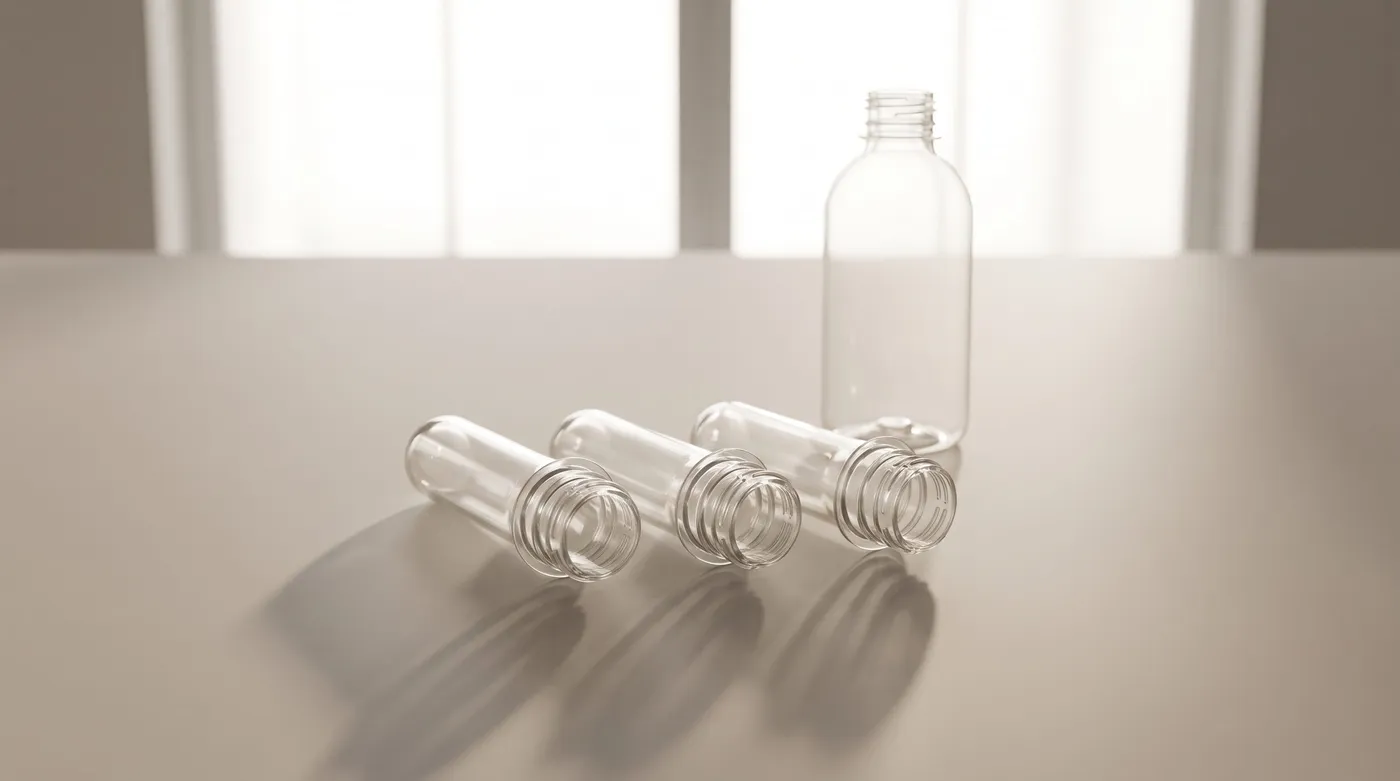
A test tube with a finished neck
The preform is injected first: molten PET is pushed into a mould that gives it the shape of a thick tube, closed at the bottom. Its neck is already finished, thread and support ring included. It will not change again.
That is the idea of injection blow moulding: finish the neck by injection, to size, before blowing the body. See extrusion vs injection blow moulding.
Stretch, then blow
For PET, blowing is often combined with stretching. The heated preform is pulled lengthwise by a rod, then inflated widthwise by compressed air. The polymer chains are thus oriented in two directions: this is biaxial orientation.
That double stretching makes the wall stronger and improves its gas barrier: the crossed chains leave less room for molecules to pass. It is what allows a bottle to be light yet strong.
One step or two
Two set-ups exist.
- Single-stage: the preform is injected, temperature-conditioned and blown on the same machine, keeping the heat from injection.
- Two-stage: preforms are made on one side, stored, then reheated and blown later, often elsewhere.
Everything is decided in the preform
Material weight, wall thickness distribution, neck dimensions: everything the bottle will be is already written into the preform and its mould. A badly injected neck cannot be saved at the blowing stage. See bottle neck finish and our expertise.
A PET bottle is just a preform that grew up. Everything expected of it, lightness, clarity, a neck that closes properly, was already there, only smaller.
Glossary
- Preform
- An injected blank with a finished neck, later blown into a bottle.
- Stretch blow moulding
- A process that stretches the preform with a rod before inflating it with air.
- Biaxial orientation
- Orientation of polymer chains in two directions, which strengthens the wall.
- Support ring
- A ring under the neck used to hold and convey the preform.