Hot filling: what the heat demands of a bottle
A fruit juice leaves the pasteuriser, still hot, and goes straight into its bottle. The heat protects the product, but it tests the packaging twice: during filling, then during cooling.
By Tecmom editorial team · 2 min read
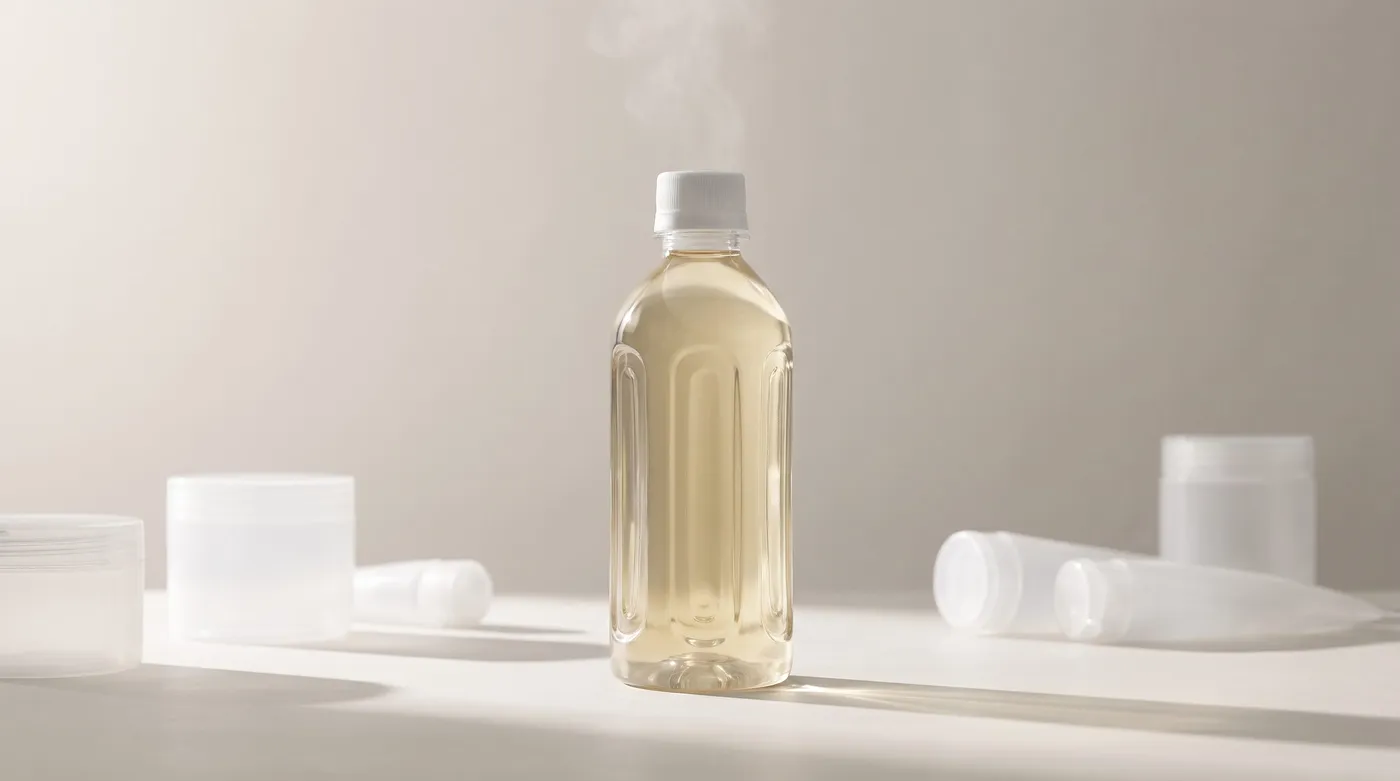
Why fill hot
Hot filling means packing a liquid food, such as a juice, a tea or a sauce, right after pasteurising it, at a high temperature: often around 85 °C, and between 68 and 96 °C depending on the product.
The hot liquid treats the inside surface of the bottle on the way. The bottle is often tilted or inverted for a moment, so the liquid also reaches the inside of the cap. Then it is cooled quickly, to preserve the product's taste.
Ordinary PET does not cope
The PET of a water bottle softens around its glass transition temperature, between 67 and 81 °C. Filled at 85 °C, it shrinks and deforms.
For hot filling, bottles are therefore heat set: the preform is blown into a heated mould, at around 120 to 130 °C, and held against its walls for a few seconds. PET's crystallinity rises, and the bottle keeps its shape at filling temperature while staying clear. See the PET preform.
The vacuum of cooling
The second test comes after capping. As it cools, the liquid contracts, and a vacuum forms inside the closed bottle. A smooth wall would collapse anywhere.
Hence vacuum panels: areas of the wall designed to flex inwards in a controlled way, without distorting the rest of the bottle. Their geometry is decided in the blow mould, together with that of the base and shoulder.
Material, neck and contact
The neck matters too. It must stay round and tight when hot; some bottles get a crystallised finish, more resistant to temperature. Polypropylene, which withstands heat better, is another route. Glass remains compatible with hot filling.
Finally, temperature is one of the conditions that determine what a pack may release into food: see food contact. A bottle designed for cold filling is not filled hot without being checked again.
A heat-set juice bottle looks like a water bottle. Its panels, neck and crystallinity tell the story of a completely different manufacture.
Glossary
- Hot filling
- Packing a hot liquid food right after pasteurisation.
- Glass transition
- The temperature at which an amorphous polymer goes from rigid to soft.
- Heat setting
- Blowing into a heated mould, which raises PET's crystallinity and heat resistance.
- Vacuum panel
- An area of wall designed to flex under the vacuum created by cooling.