HDPE: high-density polyethylene, the material of opaque bottles
The white bottle of a veterinary syrup, the can of a farm product, the bottle of a shampoo: many are made of HDPE. This polyethylene owes its qualities to an almost straight molecular chain, and its limits too.
By Tecmom editorial team · 2 min read
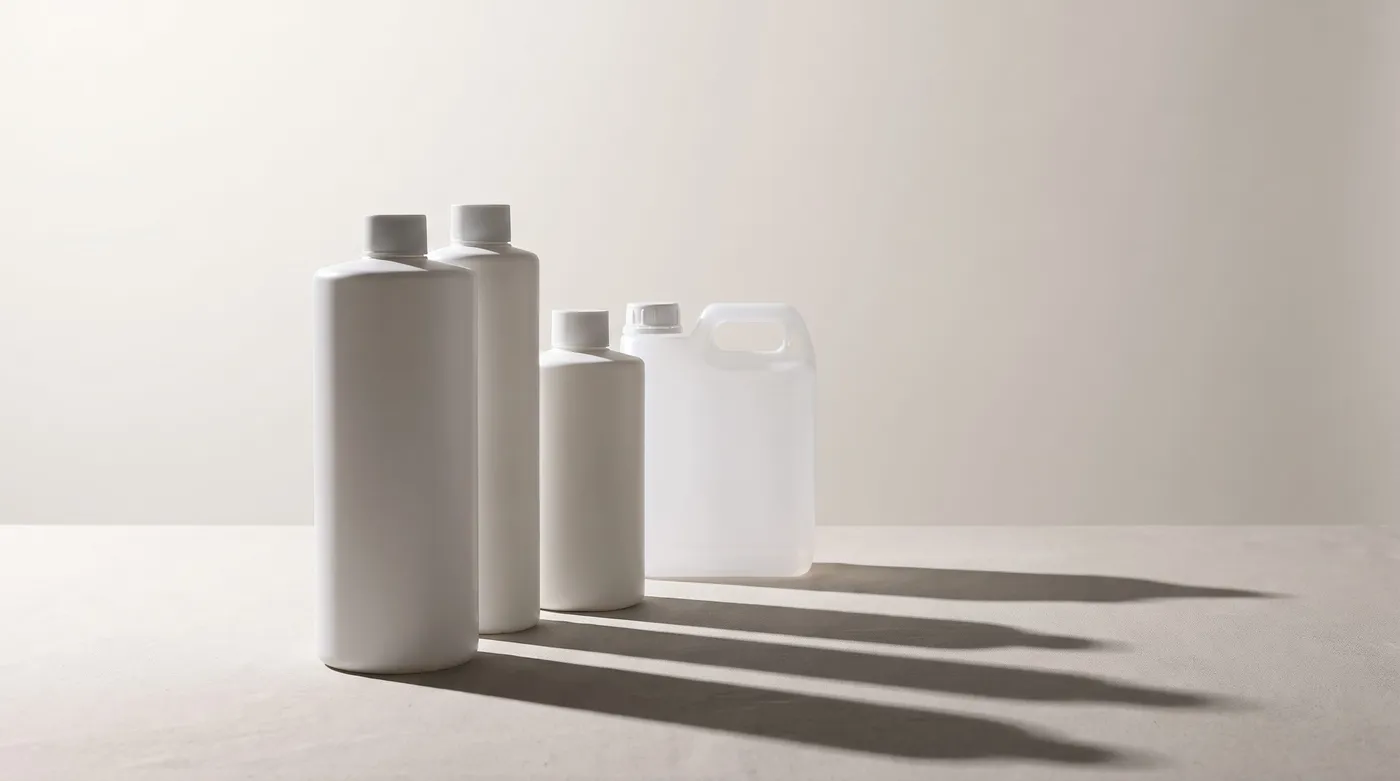
A chain with almost no branches
HDPE (high-density polyethylene), like every polyethylene, is made of long chains of ethylene. What sets it apart is that these chains carry very few branches. They pack tightly against one another in crystalline regions: the material is denser, at least 0.941 g/cm³, stiffer and stronger than LDPE, low-density polyethylene.
This packing also explains how it looks. Crystals scatter light: an HDPE bottle is milky white, never clear like a PET bottle. To compare the two polyethylenes, see HDPE vs LDPE.
What it does well
HDPE resists most acids, bases and aqueous solutions, and it takes impacts without breaking, even in the cold. It stops water vapour well: little of an aqueous liquid evaporates through it, and a powder stays dry inside.
That is why it appears in all four markets: bottles for medicines and veterinary products, cosmetic bottles, cans and jerrycans.
What it does less well
Its oxygen barrier is poor: oxygen passes through an HDPE wall far more easily than through a PET wall. A content that oxidises therefore needs another material or a multilayer wall; see permeability.
It is also vulnerable to some contents. Surfactants, oils and fragrances can make it crack under stress: this is environmental stress cracking, which is checked by testing with the real product.
Blown or injected, always the same polymer
HDPE bottles and cans are blow moulded: by extrusion blow moulding for large volumes and handles, by injection blow moulding for small bottles with a precise neck. Caps and technical parts are injection moulded.
Each process needs its own grade. A blow-moulding HDPE flows slowly and holds together when molten; an injection HDPE flows fast to fill the mould: this is what the melt flow index measures.
Recycling code 2
HDPE carries code 2 of the resin identification marking. It is sorted and recycled with other polyethylene bottles; see recycling codes. To compare it with PET and PP, see our advice page HDPE, PET, PP.
HDPE does not shine and cannot be seen through. That is often exactly what is asked of it: to protect, to take the knocks, to last.
Glossary
- HDPE
- High-density polyethylene, with little-branched chains.
- Crystallinity
- The share of the material where chains are packed in order; it makes HDPE dense and opaque.
- Barrier
- A wall's ability to slow the passage of a gas or water vapour.
- Extrusion blow moulding
- A process that inflates a tube of molten material in a mould; it allows handles.