Plastic jerry cans: the handle, the neck and the cap
The jerry can was born in steel, for the army, in the 1930s. Today it is plastic, from 1 to 30 litres, and carries oil as readily as livestock products. Its shape, though, has kept almost the same logic.
By Tecmom editorial team · 2 min read
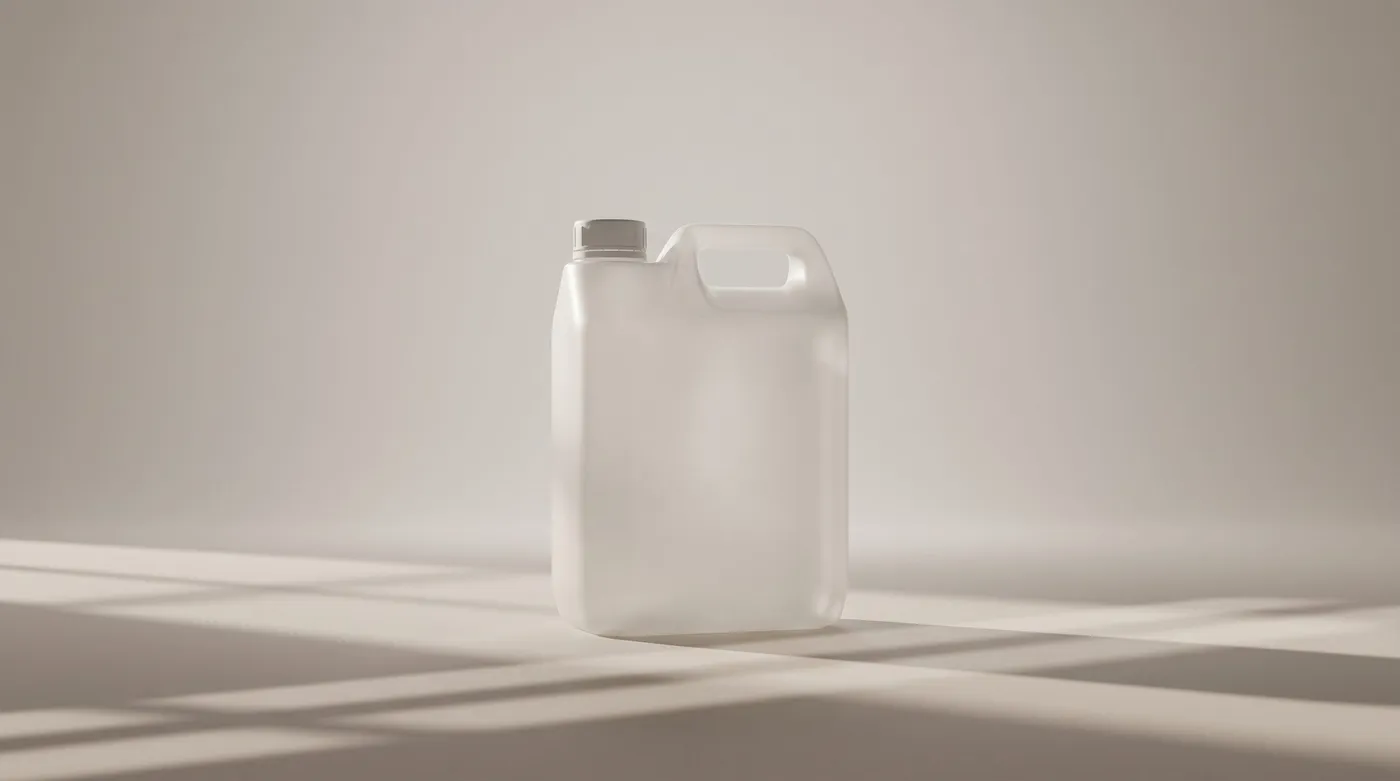
A name from the war
The first jerry can was designed in Germany in the late 1930s to carry fuel: pressed sheet steel, three handles, cross-shaped ribs for stiffness. Allied soldiers adopted it and gave it its name, Jerry being British slang for Germans.
The word stuck for any can with an integrated handle, whatever its material. In plastic, it is almost always HDPE, high-density polyethylene: light, impact-resistant, compatible with a wide range of food and technical liquids.
A hollow handle, born of blow moulding
A plastic jerry can is most often made by extrusion blow moulding: a tube of hot material is pinched between the two halves of a mould, then inflated with air against its walls. The handle is formed in the same movement, hollow, in one piece with the body.
This process is what allows closed shapes and handles without assembly. See our article on extrusion and injection blow moulding.
The neck, the cap and the air
A jerry can pours well when air can get in as the liquid flows out. Without an air inlet, the flow comes in gulps and the liquid splashes. Larger models provide a vent for this, or a wide enough neck.
The cap provides the seal, often with a tamper-evident band that shows first opening; see our article on tamper-evident packaging. Some cans carry a translucent stripe that shows the fill level.
Stacking, shipping, certification
Jerry cans travel in cases or on pallets: their rectangular shape limits empty space and makes stacking easier, provided the wall can take the load. For dangerous goods, transport requires packaging certified to the UN recommendations, after drop, leakproofness and stacking tests.
The Tecmom catalogue includes two 1-litre PE jerry cans, a short model and a long one.
The jerry can changed material, not purpose: carry a liquid in one hand, pour it without losing any, and set it on another without it giving way.
Glossary
- Jerry can
- A rigid can with an integrated handle.
- HDPE
- High-density polyethylene, the material of plastic jerry cans.
- Extrusion blow moulding
- A process that inflates a tube of hot material inside a closed mould.
- Stacking test
- A test that checks whether a package can bear the load of others placed on it.