Environmental stress cracking: when the contents crack the bottle
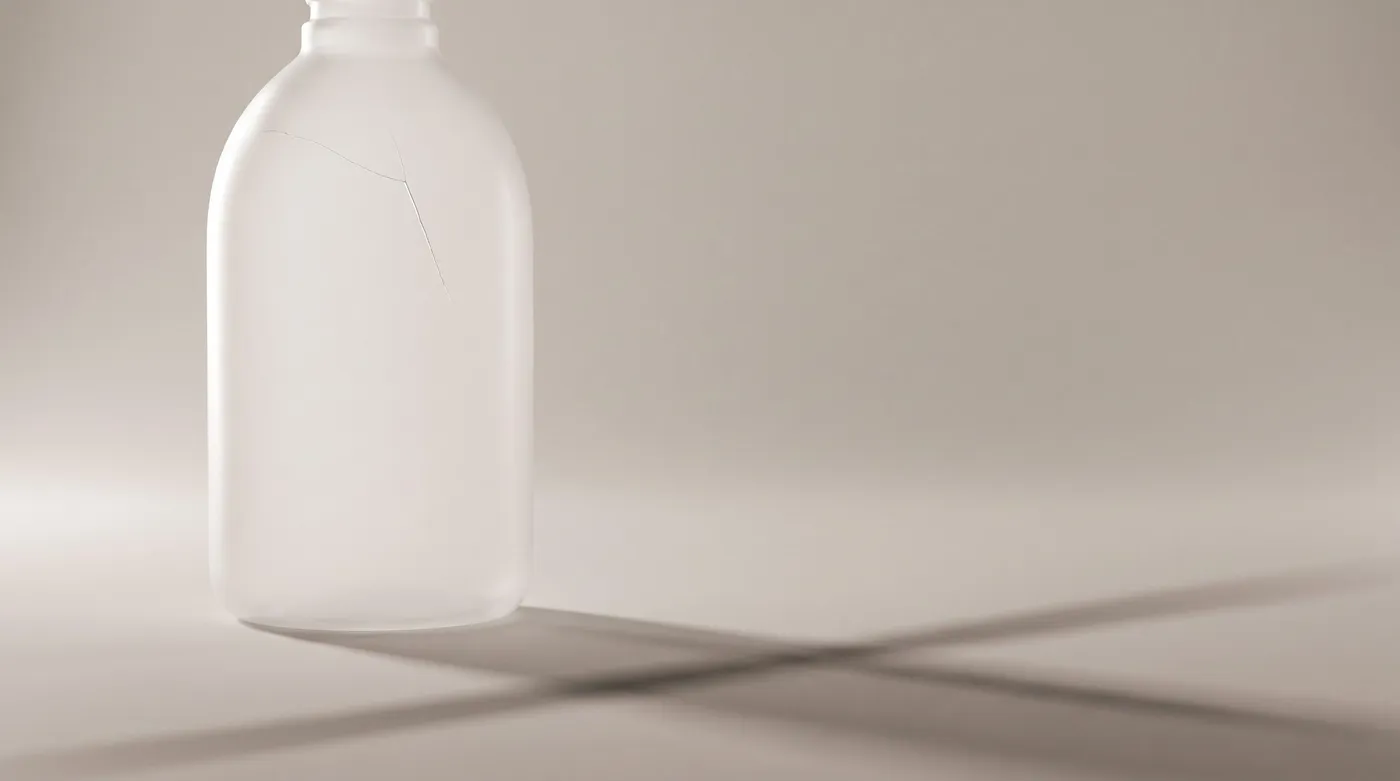
The bottle passed every check. Filled, capped and cased, it goes to the warehouse. Three weeks later, a fine crack appears near the shoulder, and the product leaks. Neither the bottle alone nor the product alone was at fault: it was their meeting.
By Tecmom editorial team · 2 min read
A defect with three conditions
Environmental stress cracking, often called ESC, brings three conditions together. A susceptible material, such as polyethylene. A tensile stress, even a small one, well below what would break the part dry. And an active agent in contact with the wall.
The agent does not dissolve the plastic or attack it chemically. It works its way between the polymer chains where they are stretched, and helps them disentangle. A microcrack forms, then grows slowly, sometimes over weeks.
The agents that cause cracking
Surfactants are the best known: detergents, soaps, wetting agents. Then come certain oils, fragrances and solvents. These are common ingredients in cosmetics, hygiene, veterinary and cleaning products; see our article on essential oils.
HDPE is not the only one concerned. PET can crack in contact with alkaline solutions, and some amorphous clear plastics are sensitive to solvents.
Where the stress comes from
Stress does not always come from outside. A moulded part keeps residual stresses, frozen in during cooling, especially near thick sections or gates. Added to these are the load of stacked cases, an overtightened cap pulling on the thread, or the pressure of a product that gives off a little gas.
Heat speeds everything up: a warm warehouse reveals in a few weeks what a cool one would have taken months to show.
Preventing and testing
The first remedy is the material: not all HDPE grades resist equally, and grades designed for cracking resistance often have longer chains and a suitable structure. The choice is made with the resin supplier; see HDPE vs LDPE.
The second is testing. The ASTM D1693 method bends notched specimens and immerses them in a surfactant solution: the time to cracking is recorded. It is used to compare materials, but it does not replace testing the real bottle, filled with its product, under accelerated storage conditions.
Environmental stress cracking is a three-way affair: material, stress, product. It is only prevented by testing them together, before the warehouse does it for us.
Glossary
- Environmental stress cracking
- Slow failure of a plastic under the combined effect of stress and an active agent.
- Surfactant
- A substance that lowers surface tension: detergent, soap, wetting agent.
- Residual stress
- Stress frozen into a moulded part during cooling.
- Specimen
- A sample of standard shape intended for a test.