Nitrosamines: why packaging is part of the inquiry
In 2018, traces of a probable carcinogenic impurity were found in blood pressure medicines. Since then, laboratories have been looking for where nitrosamines come from. The most unexpected answer came from a pack.
By Tecmom editorial team · 2 min read
The sartan case
Nitrosamines are compounds formed when an amine reacts with a nitrosating agent, such as nitrogen oxides or nitrites. Several of them, including NDMA (N-nitrosodimethylamine), are considered probable carcinogens.
According to the European Medicines Agency (EMA), EU regulators became aware of them in mid-2018, when NDMA was detected in blood pressure medicines of the sartan family. A scientific review followed, and marketing authorisation holders must since assess the risk for each of their products.
An unexpected source: the blister lidding
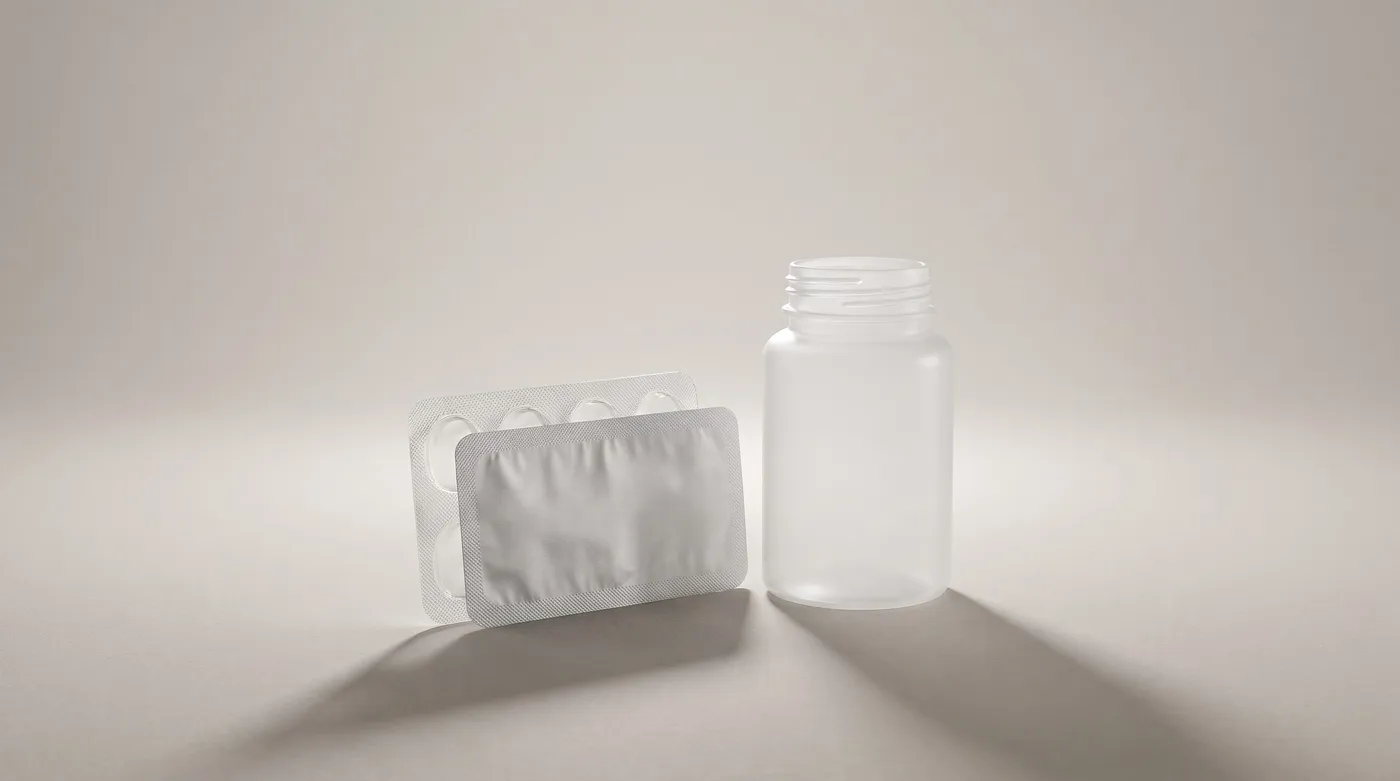
The first suspect was the synthesis of active substances. Packaging joined the list of possible causes in 2019. A marketing authorisation holder observed nitrosamines in tablets packed in blisters whose aluminium lidding foil carried a nitrocellulose printing primer.
The hypothesis: during heat sealing, the heat releases nitrogen oxides, which react with amines from the ink; the nitrosamines formed then transfer to the product. A study supported this lead: without a nitrocellulose primer, neither NDMA nor NDEA formed. To compare formats, see blister packs vs bottles.
What the laboratory assesses
The risk assessment covers everything that goes into the medicine or touches it. For packaging, the laboratory lists every component: bottle, cap, liner, seal, inks and primers of any decoration. For each one, it asks whether amines or nitrosating agents may be present, and whether a packaging step, such as heat sealing, could make them react.
The approach mirrors that of extractables and leachables: first what a material could release into the medicine, then what it actually releases.
What the packaging manufacturer brings
The laboratory cannot conclude without data. The packaging manufacturer contributes by documenting the composition of its materials, their additives and any decoration processes, and by reporting every change. This is the role of primary packaging, whose material is written into the medicine's dossier.
This article attributes an absence of risk to no material: it is the laboratory's assessment, component by component, that concludes.
The nitrosamine case was a reminder of a simple rule: packaging does not merely contain. It can also react, so it is part of the inquiry.
Glossary
- Nitrosamine
- A compound formed by the reaction of an amine with a nitrosating agent; several are probable carcinogens.
- NDMA
- N-nitrosodimethylamine, the nitrosamine detected in sartans in 2018.
- Heat sealing
- Sealing a lidding foil with heat and pressure.
- Nitrocellulose
- A polymer used in some printing primers and inks.