Blister or bottle: two ways to pack a tablet
A tablet is sold either in a blister, one cavity per dose, or in a bottle where all the doses sit together. Neither is better in itself: they do not protect in the same way, nor against the same risks.
By Tecmom editorial team · 2 min read
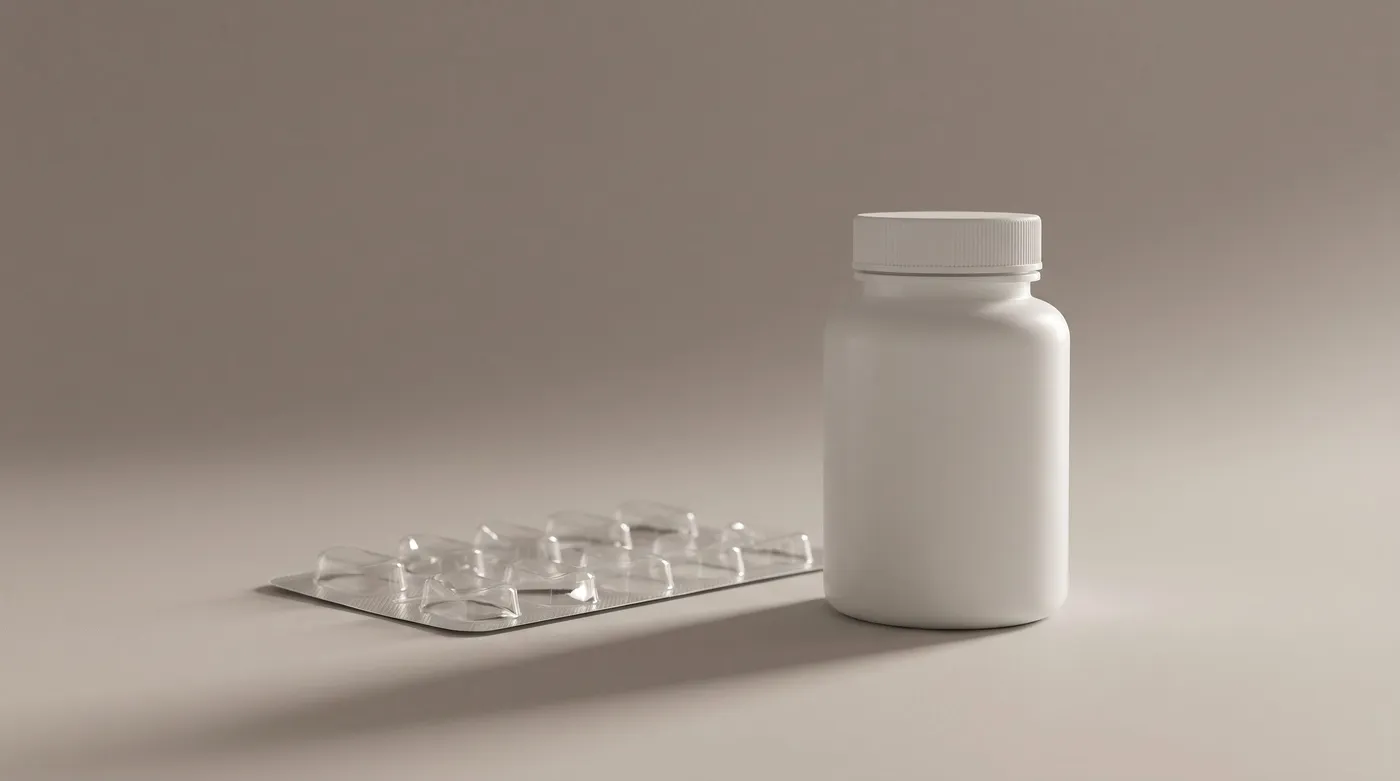
Two ways of protecting
A blister isolates each dose. A formed sheet with cavities receives the tablets, then a lidding foil, often aluminium, seals it. The patient pushes a tablet through the lid: the others stay closed until their turn.
A bottle protects the whole. A wall, a neck, a cap: as long as the closure is shut, every dose is sheltered. But at each opening, the entire contents meet the air of the room, and its moisture. Hence the use of a desiccant in bottles and tubes for sensitive products. See silica gel.
Not all cavities are equal
A blister's barrier depends on its formed sheet. PVC alone gives basic protection against moisture; coated with PVDC, or laminated with a fluorinated film, it protects more. The "cold-form" blister, in aluminium formed without heating, gives the strongest barrier, at the cost of an opaque, more expensive and bulkier pack.
A bottle works with other levers: wall material and thickness, closure tightness, desiccant, quantity per bottle. A small bottle, emptied quickly, is opened less often than a large one.
What tips the choice
Several criteria add up:
- product sensitivity to moisture, oxygen, light;
- the number of doses: a short course or a box of twenty suits a blister, a long treatment or large packs suit a bottle;
- use: a blister slips into a pocket, dose by dose; a bottle suits large or irregular forms, such as bulky capsules or effervescent tablets;
- market habits and the equipment of the packaging line.
The final choice is made on evidence: stability studies, run under the ICH Q1A guideline in the pack that will be marketed, show whether the protection is enough. And that choice goes into the medicine's file. See primary packaging.
The bottle side
On the bottle side, Tecmom makes HDPE and PET bottles, pill containers and rigid tablet tubes. Blisters belong to another trade, thermoforming. See the catalogue and pharmaceutical packaging.
Blister or bottle, the question is never about looks. It comes down to another one: how many times will the tablet see the air before it is swallowed, and can it take it?
Glossary
- Blister
- A pack of formed cavities, one per dose, closed by a lidding foil.
- Lidding foil
- A sealed sheet that closes a blister cavity or a bottle neck.
- Desiccant
- A material that captures moisture from the air inside a pack.
- Stability study
- Monitoring a medicine in its pack, under defined conditions, to set its shelf life.