Primary packaging: what touches the medicine
A medicine is sold in several nested layers of packaging, but only one of them touches it. That primary packaging is part of the product: its material goes into the marketing authorisation file, and changing it is never a unilateral decision.
By Tecmom editorial team · 3 min read
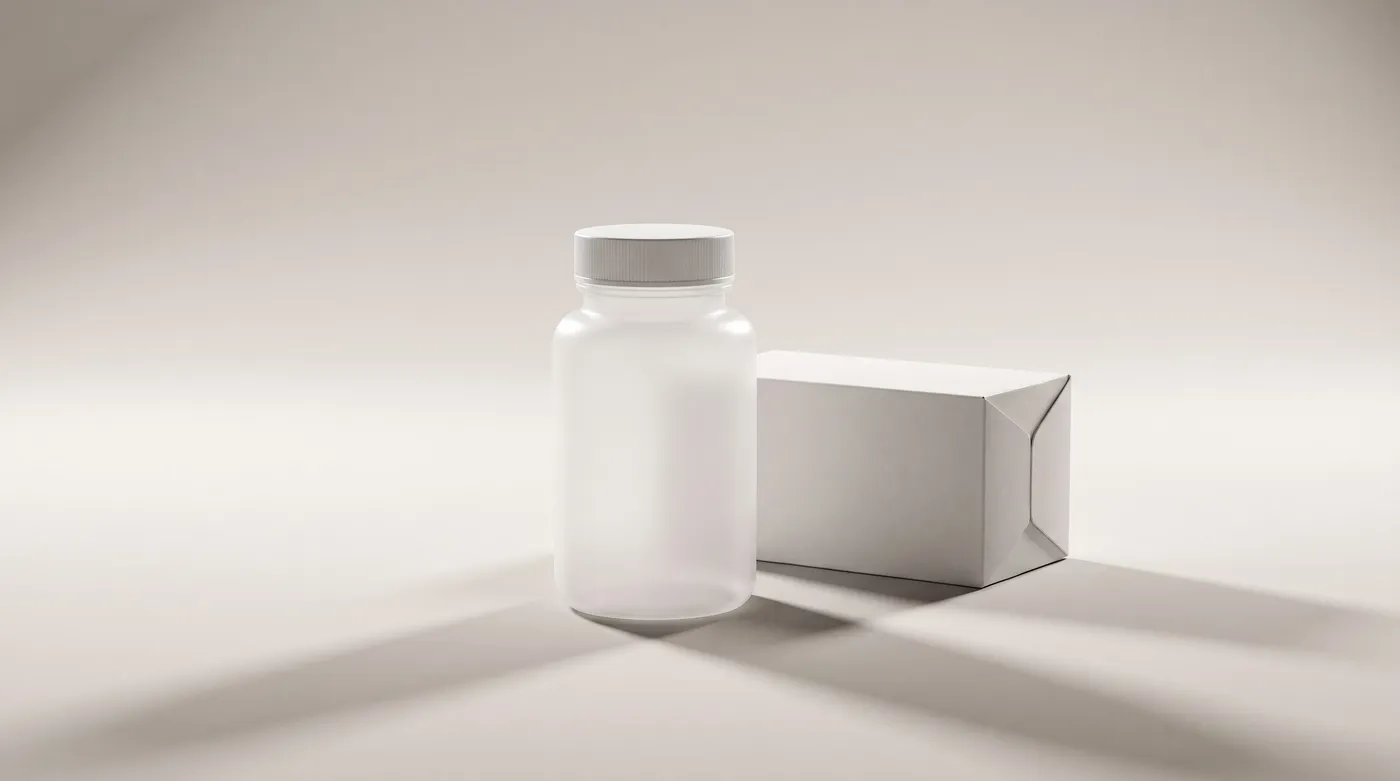
A boundary, not a box
The European directive 2001/83/EC, which governs medicinal products for human use, gives the definition: immediate packaging is the container or other form of packaging immediately in contact with the medicinal product. Outer packaging is the packaging into which it is placed.
The US FDA sharpens the criterion in its guidance on container closure systems: a component is primary if it is, or may be, in direct contact with the dosage form. The nuance matters. The inside of a cap does not touch a syrup while the bottle stands upright, but it does as soon as the bottle lies down: it is primary, just like the bottle.
Primary, secondary, transport
Common usage distinguishes three levels:
- primary, which touches the product: bottle, cap, pill container, tube;
- secondary, which never touches it: the folding carton and its leaflet;
- transport packaging, which groups cartons for the pallet and the truck.
The consequence is simple. Secondary packaging informs and protects against knocks; only primary packaging interacts chemically with the medicine. That is why it is the one that gets qualified, tested and described in the authorisation file.
What regulators ask of a material
For plastic packaging, the European Medicines Agency has a dedicated guideline. It asks for a description of the material, additives included, and for a study of the exchanges between container and contents: what can migrate from the plastic into the medicine, and what the plastic can take up from the medicine. The more liquid the product, the deeper the study.
Protection comes on top: against moisture, oxygen or light, depending on how sensitive the active substance is. Stability studies are run in the pack that will be marketed. Hence the rule that shapes the whole trade: changing the material or the supplier of a primary pack must be justified to the authority.
Three materials, three uses
In the Tecmom range, three materials share the primary packaging. HDPE, opaque and white, for bottles holding dry forms and for dropper bottles. PET, clear or amber, for syrup bottles. PP, for pill containers and rigid tablet tubes. Their differences in barrier and strength are covered in our advice page HDPE, PET, PP.
The choice of material is never made in isolation: it depends on the dosage form, its sensitivity and the process that will form the part, injection moulding for a pill container, injection blow moulding for a bottle. See pharmaceutical packaging.
What ISO 15378 adds
Making primary packaging already means working for a medicine's file. ISO 15378 takes ISO 9001 and adds Good Manufacturing Practice (GMP), applied to the items that touch the medicine: risk management, change control, traceability back to the raw material lot.
Tecmom is certified to ISO 9001 and ISO 15378, and produces in a controlled environment. See what the standard requires and our approach to quality.
A carton can be redesigned in a week. A bottle that touches a medicine commits a file, studies and years of stability data. That is what the standards on primary packaging exist for: nothing in it changes by chance.
Glossary
- Primary packaging
- Container or form of packaging in direct contact with the medicine; the EU calls it immediate packaging.
- Outer packaging
- The packaging into which the primary pack is placed; also called secondary packaging.
- Migration
- Transfer of substances from the packaging into the product it holds.
- GMP
- Good Manufacturing Practice: the discipline that makes every lot reproducible and traceable.