Glossy, satin, textured: a part's look is decided in the steel
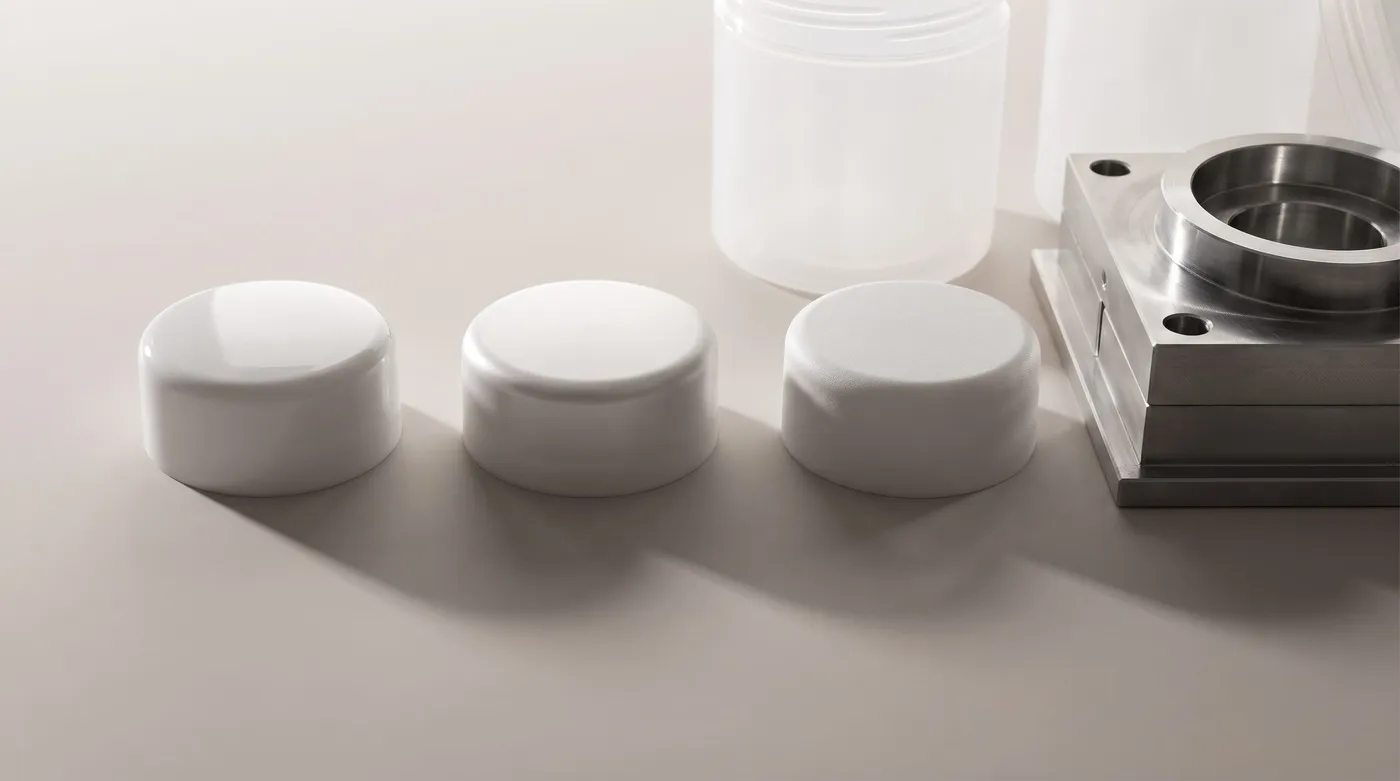
A mirror-bright cap and a cap with a soft-touch feel can come off the same press, in the same material. The whole difference lies in the surface of the mould, which the part copies faithfully.
By Tecmom editorial team · 2 min read
The part copies the mould
In injection moulding, molten material is pressed against the steel: it takes on every detail, down to the finest scratches. The surface finish of the cavity becomes that of the part. A polished mould gives a glossy part; a textured mould, a matt or grained one.
That is why the look of cosmetic packaging, where appearance is a first-rank criterion, is decided when the mould is designed and finished. See our article on cosmetic variants.
Two scales to speak the same language
The SPI scale, of American origin, sorts finishes into four families: A for diamond polishing, the glossiest; B for abrasive paper; C for stone; D for blasting, the most matt. Each family has three levels.
The VDI 3400 scale, of German origin, describes textures produced by electrical discharge machining. Its number derives from roughness: VDI 12 corresponds to an average roughness of about 0.4 micrometres, VDI 30 to about 3 micrometres. The higher the number, the rougher the surface. See our article on EDM machining.
What a texture requires
A textured surface grips the part more during ejection. A larger draft angle is then needed, meaning slightly more inclined walls, so that the part comes out without being scratched. A workshop rule of thumb often quoted calls for about one extra degree of draft per 25 micrometres of texture depth.
Texture has advantages too: it hides small cosmetic defects, such as a slight sink mark or a weld line, that gloss shows up. See our article on injection moulding defects.
Clarity and polishing
For a clear part, the polish must be flawless: the slightest scratch in the steel shows in the part. Mirror polishing calls for steels that lend themselves to it and a lot of hand work; see our article on mould steel.
Surface finish is therefore specified from the outset, zone by zone: the same cap can have a textured top and a polished skirt.
A glossy cap is not better made than a textured one. It is a cap whose mould was polished for it, and whose design planned for it.
Glossary
- Surface finish
- The look and roughness of a surface, here that of the mould cavity.
- VDI 3400
- A German scale of EDM textures, based on roughness.
- SPI
- An American scale of mould finishes, from A, glossy, to D, matt.
- Draft angle
- The slight incline of a part's walls that eases ejection.