Sink marks, flash, short shots: reading the defects of a moulded part
A dip on top of a cap, a thread of plastic along its edge, a part that leaves the mould unfinished: every injection moulding defect has a cause, and often a signature that leads back to it.
By Tecmom editorial team · 2 min read
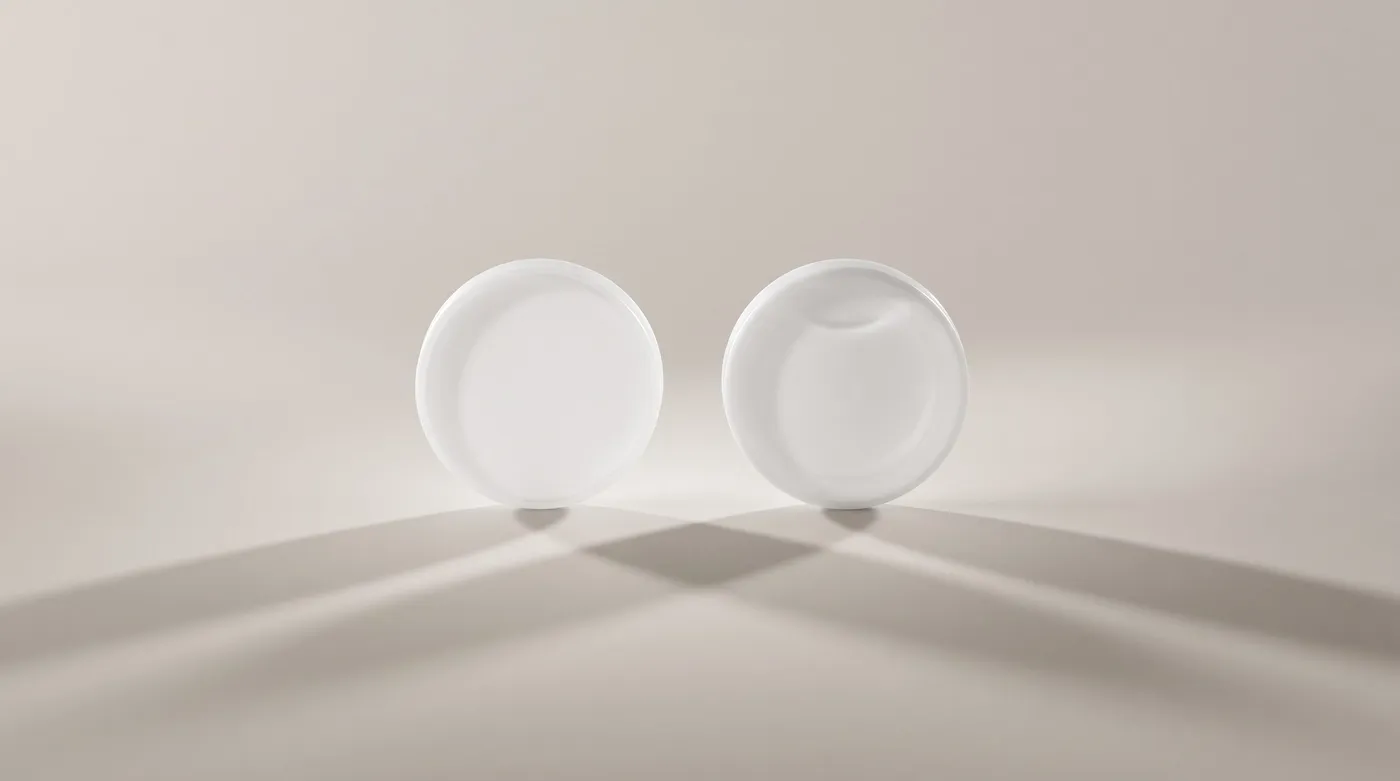
The sink mark, or the core that cools last
A sink mark is a slight dip on the surface of a part, above a thick area: a rib, a boss, a base that is too massive. The skin of the part freezes against the mould, then the still-hot core shrinks as it cools and pulls the surface inwards. When the skin holds, the shrinkage leaves a bubble inside instead, a void.
The cure starts at the design stage: even wall thicknesses. On the machine, a longer holding pressure makes up for part of the shrinkage. See also our article on parting lines and shrinkage.
Flash, or material that escapes
Flash is a thin film of plastic that spills beyond the part, most often along the parting line, where the two halves of the mould meet. The material has slipped into a gap it should never have found.
The causes are well known: a mould worn or damaged on its shut-off faces, clamping force too low for the injection pressure, material that flows too easily. On a cap, flash in the wrong place hinders screwing or sealing.
The short shot, or the unfinished part
A short shot leaves the mould with a section missing, often at the point furthest from the gate. The material froze before filling the whole cavity.
There was not enough material, pressure or speed; or air, poorly vented, acted as a plug. That same compressed, overheated air can also leave a black burn mark, sometimes called the diesel effect. Hence the importance of vents, very thin passages that let air out without letting plastic through.
Weld lines, moisture streaks, warpage
When two flow fronts meet, around a hole for example, they leave a weld line, visible and weaker than the rest of the part. Damp, poorly dried material leaves silver streaks on the surface. Uneven cooling makes the part warp, so it comes out bowed or oval.
These defects are not only sorted by eye: they are prevented by mould design and stable settings, which is precisely what a workshop's expertise is about.
An injection moulding defect is rarely bad luck. It is a message from the mould or the settings, and a workshop that can read it does not need to sort.
Glossary
- Sink mark
- A dip on the surface of a moulded part, caused by the shrinkage of a thick section.
- Flash
- A film of material that spills beyond the part, often at the parting line.
- Short shot
- A part whose cavity was not completely filled.
- Vent
- A very thin passage in the mould that lets air escape.