Mould steel: P20, H13 or stainless, a choice made for years
An injection mould works hundreds of thousands of cycles, sometimes millions, under pressure and heat. The steel chosen at the start decides its lifespan, the quality of its polish and how it can be repaired.
By Tecmom editorial team · 2 min read
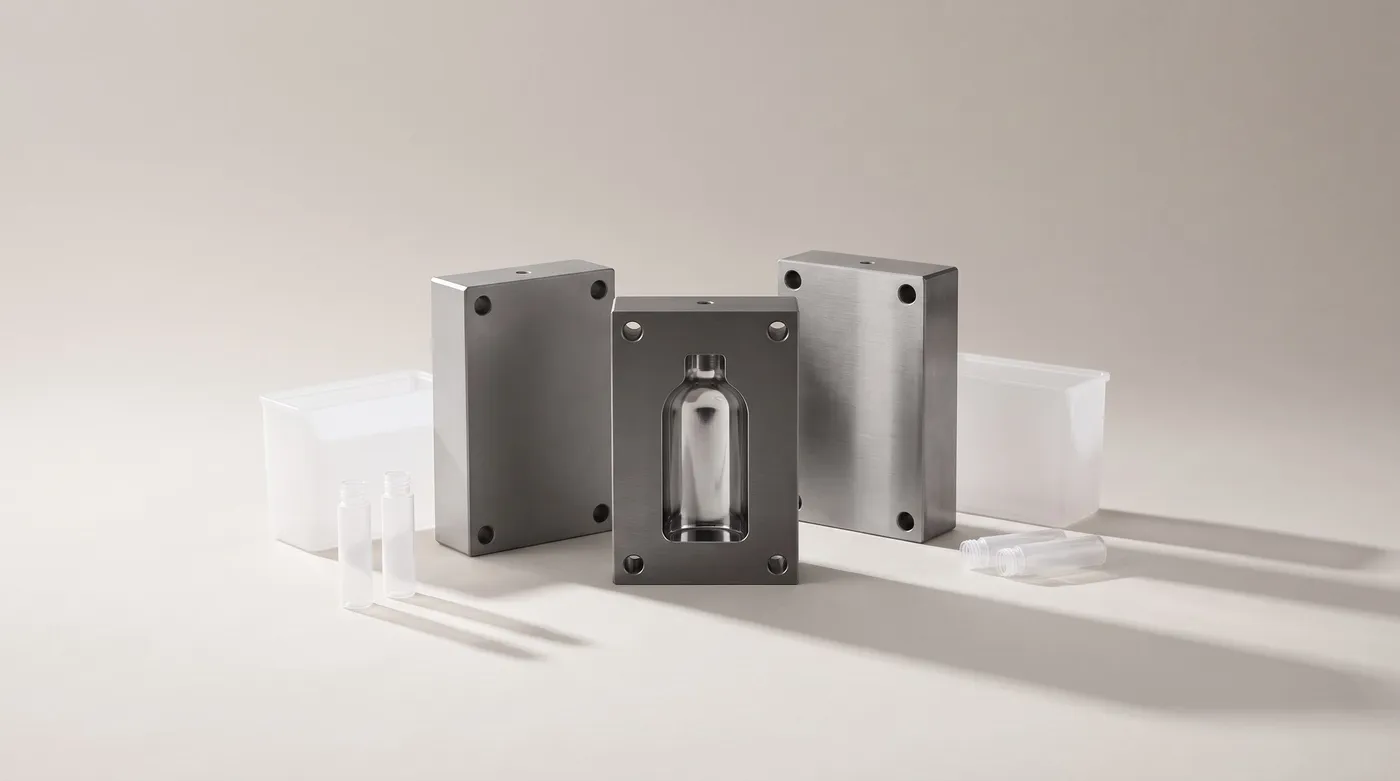
What is asked of mould steel
Mould steel must resist wear, since the material rubs at every cycle; injection pressure, which tends to open the mould; and temperature swings between hot material and cooling water. It must also polish well, machine without too much difficulty and, depending on the materials injected, resist corrosion.
No steel ticks every box to the maximum. The choice is a compromise between the expected number of parts, the desired finish and the cost.
Three common families
P20, designated 1.2311 in the European numbering, is supplied pre-hardened, at around 30 HRC. It is machined directly, with no heat treatment afterwards: it is the steel of medium-run moulds and large mould bases.
H13, or 1.2344, is a hot-work tool steel. Hardened to around 50 HRC, it resists wear and thermal shock better: it suits long runs. Stainless steels of the 420 type resist corrosion and take a mirror polish, which makes them the steels of clear parts and of production in clean environments.
Lifespan: the SPI classification
The American plastics industry association proposed a classification of moulds by expected life. Class 101 aims at over a million cycles, with hardened steels; the following classes go down to class 105, prototype moulds that produce only a few hundred parts.
These benchmarks vary from one source to another, but the logic holds: the longer the run, the harder the steel and the more careful the mould. See our article on injection mould cost.
Inserts, copper and aluminium
A mould is not made of a single steel. The most heavily loaded areas receive inserts of harder steel, replaceable when they wear. Where heat builds up, in the core of a cap for example, copper alloys are sometimes fitted, as better conductors, to cool faster.
At the other end, aluminium is used for prototype moulds and short runs: it machines quickly but also wears quickly. The finest shapes are cut by EDM machining, whatever the steel.
A mould's steel is chosen once, and lived with for years. That is why the mould maker asks about the number of parts before asking about price.
Glossary
- HRC
- Rockwell C hardness, the hardness scale for hardened steels.
- Pre-hardened steel
- Steel supplied already hardened, machined with no later heat treatment.
- Hardening
- A heat treatment that makes steel harder.
- Insert
- A separate part fitted into the mould, often replaceable.