Cosmetics: one shape, dozens of variants
In a pharmacy, two identical bottles are good news. On a cosmetics shelf it is the opposite: every range wants its own tint, feel and decoration. For the packaging maker, it all comes down to one question: what can change without remaking the mould?
By Tecmom editorial team · 3 min read
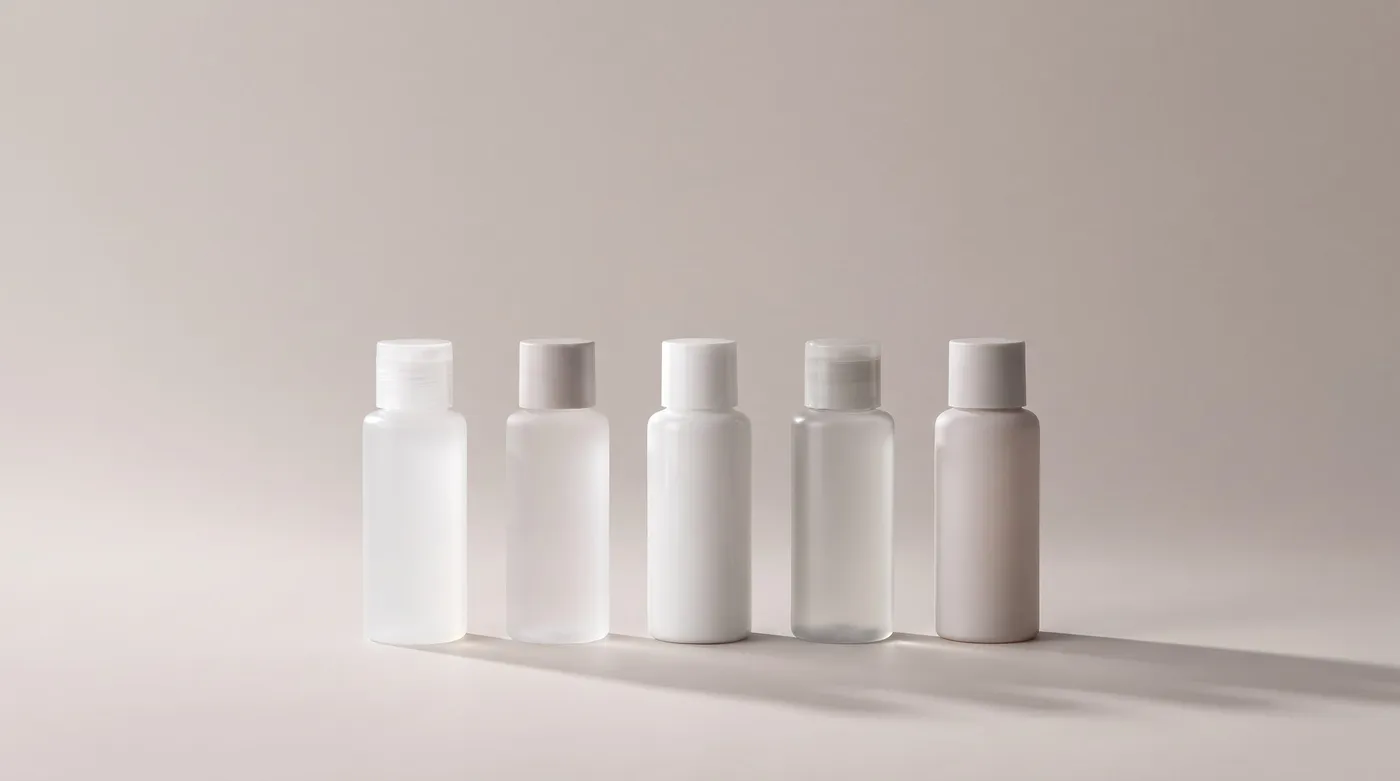
Appearance, a first-rank criterion
In cosmetics, packaging keeps the requirements of every market: it must be compatible with the formula, protect it and close properly. But appearance becomes a criterion in its own right: translucent or opaque, glossy or frosted, tinted, decorated. A single range comes in several fragrances, several sizes, several seasons.
The industrial consequence is direct: many variants on one geometry. See cosmetic packaging.
What changes without touching the mould
Some variants need no new tooling.
- Tint: it is given to the material, through a colour concentrate added to the resin. The mould does not change; the machine only needs purging between two colours.
- Applied decoration: printing, labels, marking, applied to the part after moulding.
- The cap: another cap colour or shape on the same neck changes a bottle's look without modifying it.
What means reworking the steel
Other variants are decided in the mould itself.
- Surface finish: a glossy part comes from a polished cavity, a matte or textured part from a grained cavity, for instance by electrical discharge machining. Mould makers rely on finish scales, such as the SPI scale for polish and the German VDI 3400 guideline for textures. Changing the finish means reworking the steel.
- A moulded relief or logo: it is part of the cavity.
- The shape: a new silhouette is a new mould.
Hence the value of thinking about variants at the design stage: planning interchangeable parts in the mould, inserts, allows a detail to change without remaking the whole tool. Mould design decides what will be able to vary.
Compatibility is not negotiable
A new tint is not only a matter of taste: a colourant is one more constituent in contact with the formula. In the European Union, Regulation (EC) No 1223/2009 on cosmetics requires each product's safety report to include information on the packaging material. Migration from the packaging into the product is the main concern, as industry guidance points out.
An appearance variant may therefore call for a compatibility check, just like a change of material.
What Tecmom offers
Tecmom designs and builds its moulds: that is what makes it possible to draw a shape specific to a brand and to plan from the start what will vary. See our expertise. The catalogue notably includes an 80 ml single-layer HDPE tube for creams and gels, and a 125 ml polypropylene bottle with a pouring spout.
A successful cosmetics range gives the impression of countless bottles. For the manufacturer, it is often a single well-designed mould, and a precise list of what may be changed.
Glossary
- Colour concentrate
- A concentrated colourant added to the resin to tint the part throughout.
- Surface finish
- The state of the cavity surface, from mirror polish to texture, which the part reproduces.
- Insert
- A removable part of a mould that can be swapped to change a detail of the part.
- Electrical discharge machining
- Machining by electrical sparks, used notably to texture a cavity.