Clamping force: why the size of the press depends on the part
An injection moulding machine is described by a number of tonnes. That figure is neither its weight nor what it can inject: it is the force with which it holds the mould shut. And it is the part, more than the machine, that decides what is needed.
By Tecmom editorial team · 2 min read
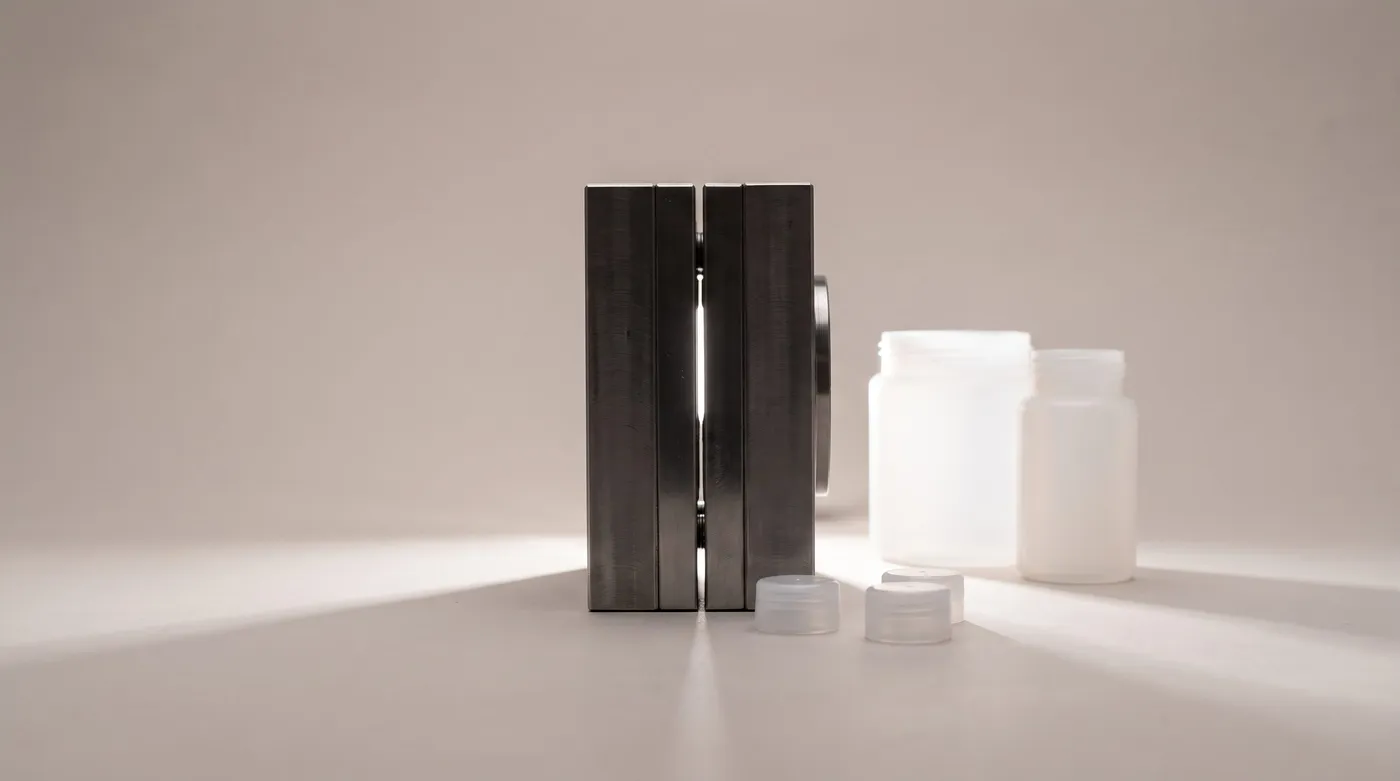
The material pushes the mould open
During injection, molten material enters the cavity under high pressure, then is held there during packing. This pressure acts on every wall of the mould, and in particular on its two halves, which it tends to push apart.
The machine's clamping unit resists it. Clamping force is the force it applies to keep the mould closed; it gives the machine its rating, expressed in tonnes or kilonewtons.
Pressure times projected area
The basic calculation is simple: the force needed is the cavity pressure multiplied by the part's projected area, that is, its outline seen in the mould's opening direction, on the parting plane. Simulation software computes this force point by point, by summing the pressure over each surface element.
Two consequences follow. A wide, flat part needs more force than a tall, narrow one of the same weight. And in a multi-cavity mould, all the cavities and the feed runners add up; see hot runner vs cold runner.
When the force falls short
If the pressure wins, the mould opens very slightly, and material seeps along the parting line: this is flash, a thin fin of plastic sticking out of the part. On a cap, flash on the thread or on the sealing lip can compromise the closure.
Conversely, a force well above what is needed does not improve the part. It wears the mould and the machine, and consumes energy for nothing.
A choice made with the mould
Clamping force is therefore decided with the mould: number of cavities, layout, size of the parting surface. It is also a matter of balance between the tooling and the machine that will receive it. See parting line and shrinkage and our expertise.
A machine's force cannot be read on its nameplate. It is read on the part, exactly where flash would appear if it were missing.
Glossary
- Clamping force
- The force that keeps both halves of the mould closed during injection.
- Projected area
- The part's area seen in the mould's opening direction.
- Parting line
- The surface where the two halves of the mould meet.
- Flash
- A thin fin of material that seeps into the parting line when the mould opens slightly.