What the mould leaves on the part: parting line and shrinkage
Run a fingernail over a cap: you may feel a fine line where the two halves of the mould met. Measure it: it is slightly smaller than the cavity that formed it. Those two traces say a lot about how the part was designed.
By Tecmom editorial team · 2 min read
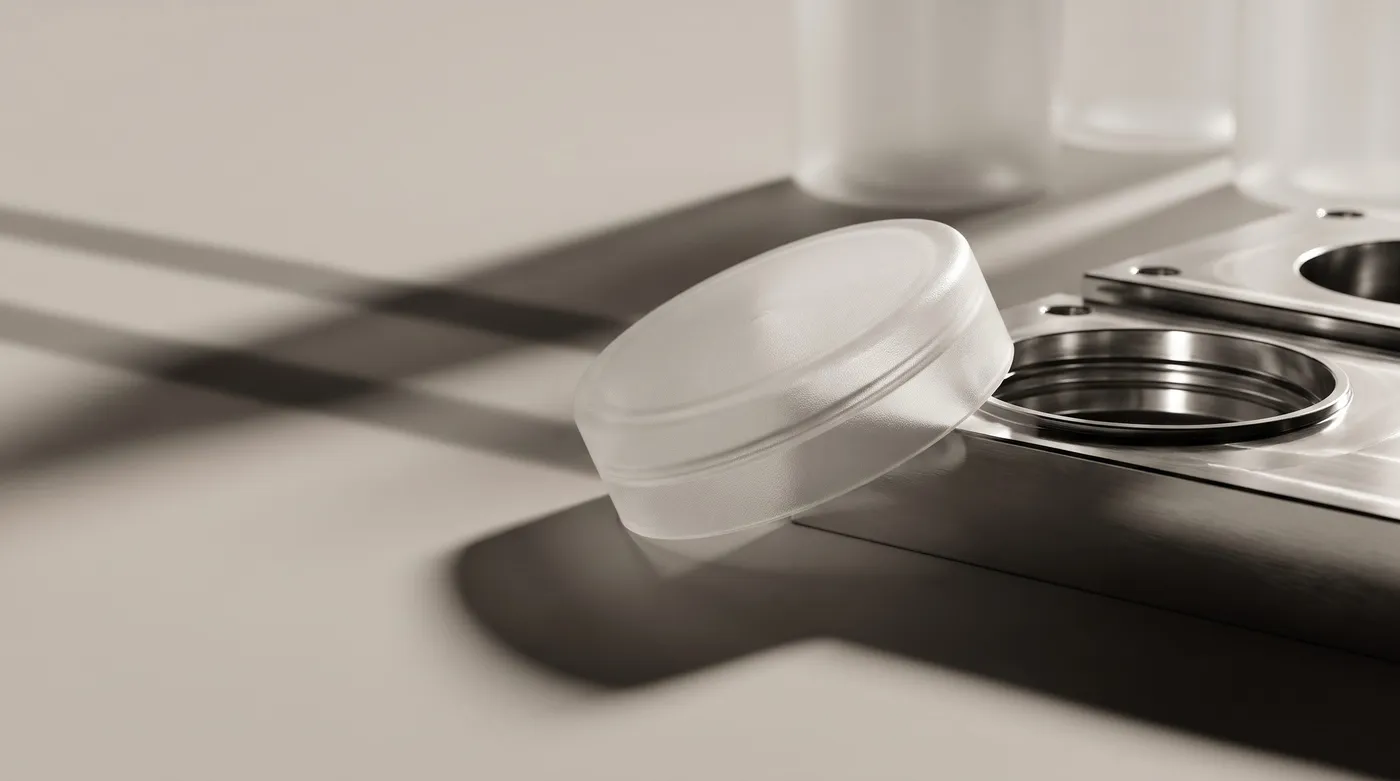
Two halves that meet
A mould opens to release the part. It is therefore made of at least two pieces, and the surface where they touch is called the parting line. On the part, it leaves a line, more or less visible depending on how well the halves fit.
If the two halves close badly, or the material is pushed too hard, it seeps into the gap and forms flash: a thin lip of plastic along the line. On a visible face it is a defect. On a sealing surface it is a possible leak.
Where to put it
The parting line is not placed at random. The designer chooses it so the part can come out of the mould, but also so it crosses neither a surface that must seal nor an area the customer looks at. On a screw cap, the top of the skirt and the inner sealing surface are what count; on a bottle, the neck.
Once the steel is machined, that choice is fixed. A line can be polished; it cannot be moved without remaking the mould.
Shrinkage, or the part that gets smaller
The material enters the mould molten and leaves it solid. As it cools it contracts: that is shrinkage. The part is therefore smaller than the cavity, and the mould has to be drawn larger, by the right amount.
That amount depends on the material. No two plastics shrink the same way. Shrinkage also depends on wall thickness, melt temperature, cooling rate and gate location. Shrinkage is not always the same along the flow and across it: that is the origin of much warping.
Why it is a sealing question
A cap thread has to engage the neck thread with a precise clearance. If shrinkage was badly anticipated, the cap grips too much or too little, and the seal is no longer guaranteed. On an injection-moulded part nothing is reworked after moulding: the thread comes out finished, right or wrong.
That is why shrinkage, parting line, gates and cooling circuit are decided together, before the first cut of steel. At Tecmom, which designs its moulds in-house, this is the heart of the trade. See our expertise and bottle neck finish.
A good injection-moulded part shows almost nothing of how it was made. That almost-nothing is the result of decisions taken weeks before the first part, when the mould existed only as a drawing.
Glossary
- Parting line
- The surface where the two mould halves meet; it leaves a line on the part.
- Flash
- A thin lip of material that seeps into the parting line gap.
- Shrinkage
- Contraction of the material as it cools in the mould.
- Gate
- The point through which molten material enters the cavity.