Hot runners or cold runners: how material reaches the mould
Between the press nozzle and the cavities, molten material travels through a small network of channels. The route looks secondary. Yet it decides what is thrown away at each cycle, what the mould costs, and how easy it is to change colour.
By Tecmom editorial team · 2 min read
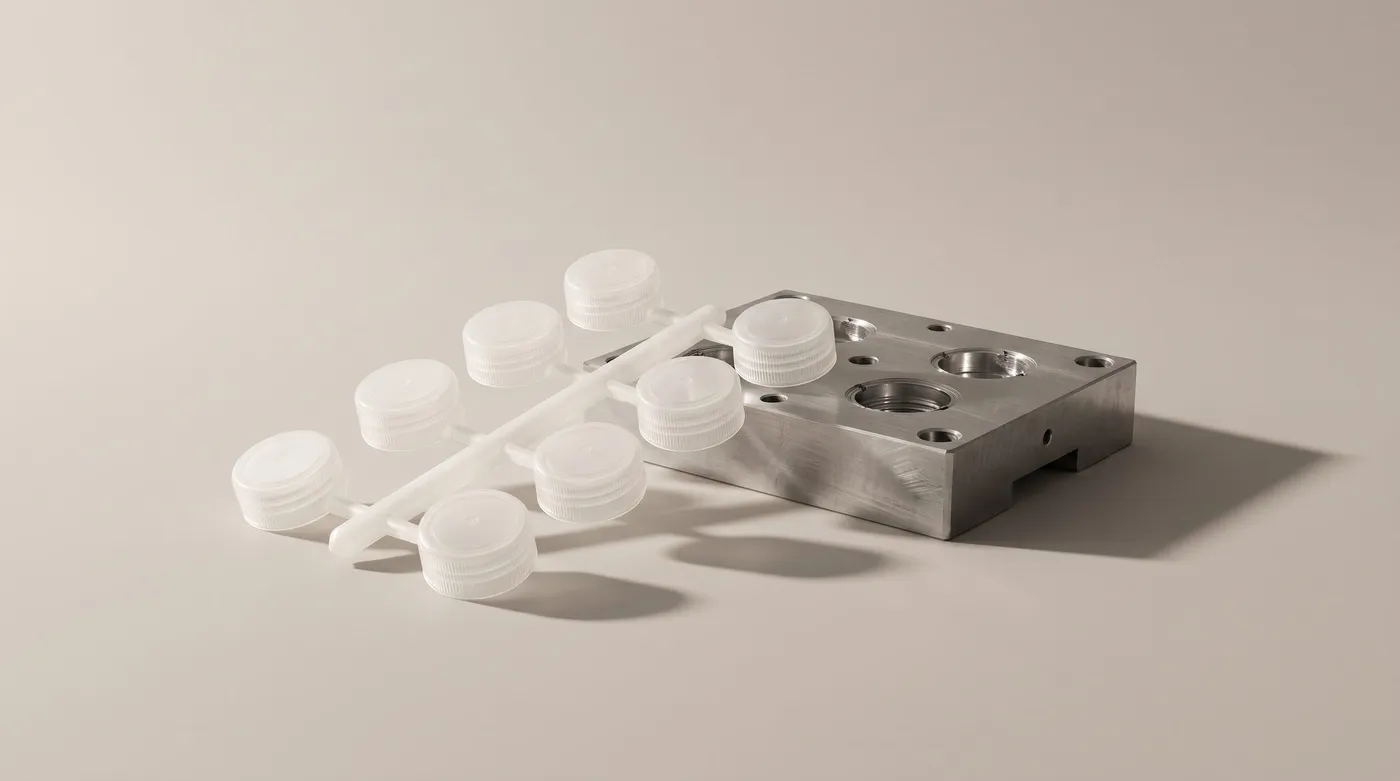
The material's route
In an injection mould, material leaves the press through a nozzle, then is distributed to the cavities through feed channels, called runners. There are two ways to design them.
- With cold runners, the channels are simple passages cut between the two mould halves. The material cools there along with the parts and comes out with them: each cycle yields parts attached to a plastic tree.
- With hot runners, a set of heated components, a manifold and nozzles, keeps the material molten up to the entrance of each cavity. Only the parts leave the mould.
What you gain, what you pay
Cold runners are simple, cheaper to build, easy to maintain, and well suited to frequent colour changes. On the other hand, the runner tree is scrap at every cycle: it can be reground and fed back, but that recycled material can alter the part's properties.
Hot runners remove that scrap and make moulds with many cavities of small parts, such as caps, easier. They cost more to build and maintain, and a colour change requires purging the whole system.
How to choose
Three questions usually decide:
- Volume: the longer the run, the more a hot runner's material savings pay off.
- Number of cavities: many small parts mean many runners, so a lot of scrap with cold runners.
- Colours: frequently changing tints argue for the simplicity of cold runners.
For a medical part, a question of consistency is added: every cavity must fill the same way, cycle after cycle.
A design decision
Like the number of cavities or unscrewing, the feed system is decided when the mould is designed and cannot be changed afterwards without reworking the tooling. See what an injection mould costs and our expertise.
You never see a mould's runners on a cap. But their trace is in the price of every part, in the material saved, and in the consistency of the run.
Glossary
- Cold runner
- A feed channel in which the material cools with the parts.
- Hot runner
- A heated system that keeps the material molten up to the cavity entrance.
- Runner tree
- The parts still attached to the material of the cold runners.
- Regrind
- Scrap material ground up and fed back into production.