Pad printing, screen printing, hot stamping: decorating a bottle
In cosmetics, decoration sells. It also lets one shape be turned into dozens of references without touching the mould. But ink does not hold on plastic by itself, and each process has its favourite shapes.
By Tecmom editorial team · 2 min read
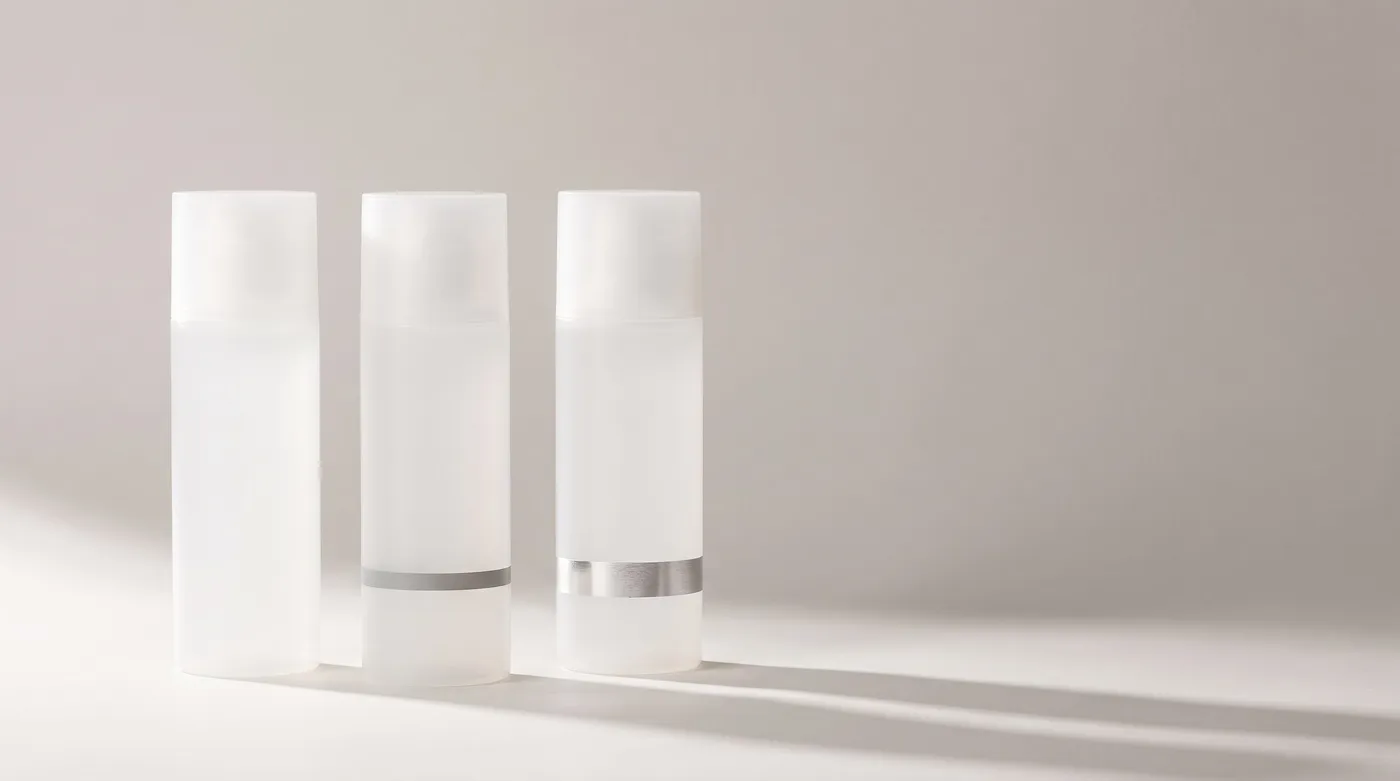
Pad printing, for curved surfaces
Pad printing transfers ink from an etched plate, the cliché, to the part, using a soft silicone pad. The pad follows the shape: it prints on a domed cap, a shoulder, an irregular surface.
The process suits small, precise designs. It lays down a thin ink film, one colour per pass.
Screen printing, for bottle bodies
Screen printing pushes ink through a fine mesh screen with a squeegee; only the open areas of the screen let ink through. On a cylindrical bottle, the part rotates under the screen.
It lays down a thicker, more opaque layer than pad printing: it is the process for large decorated areas and solid colours.
Hot stamping and in-mould labelling
Hot stamping applies a metallised or pigmented foil with a heated die, such as the gold or silver lines on a perfume cap.
In-mould labelling (IML) works differently. The label is placed in the mould before injection or blowing, and the material bonds to it: the decoration becomes one with the part. It is therefore decided at the mould design stage.
Preparing the surface
Polyethylene and polypropylene have low surface energy: ink beads up instead of gripping. Before printing, the surface is therefore treated, by flame or by electrical discharge (corona treatment), to make it more receptive. The effect fades over time: printing follows soon after treatment.
Surface finish matters too. A textured or satin bottle does not take ink like a glossy one; see mould surface finish.
Decoration is not only about looks
On medicine packaging, the ink and its primer are among the components the laboratory assesses: see nitrosamines. In cosmetics, decoration is one of the levers for variants of a single shape, along with the material's colour; see masterbatch.
Successful decoration is visible. Successful surface preparation never is: it is noticed only when it is missing.
Glossary
- Pad printing
- Printing with a silicone pad that picks up ink from an etched cliché.
- Screen printing
- Printing through a fine mesh screen.
- Hot stamping
- Transfer of a metallised or pigmented foil by a heated die.
- Corona treatment
- An electrical discharge that raises a plastic's surface energy before printing.