Silica gel: how a cap keeps tablets dry
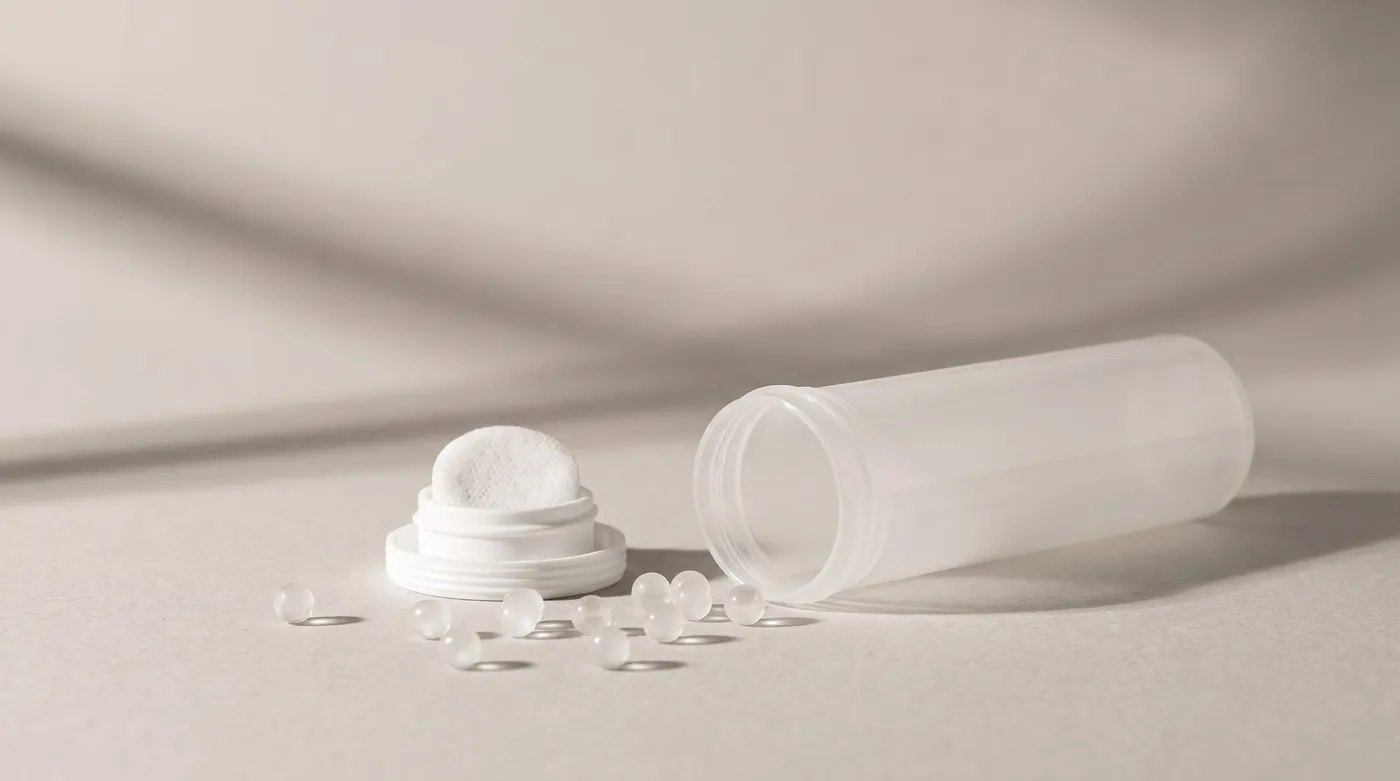
An effervescent tablet starts to fizz as soon as it meets water, and the surrounding air always holds some. Between the two stand a tube, a cap and a very special material: silica gel.
By Tecmom editorial team · 3 min read
The invisible enemy
Some medicines fear moisture above all. The textbook case is the effervescent tablet: it combines an acid and a bicarbonate that react together on contact with water to release carbon dioxide. That is the point in the glass; in the pack it is degradation. Other tablets, capsules and powders react more slowly, but just as surely.
Moisture gets in two ways: through the wall, very slowly, and at every opening, all at once. A tube of twenty tablets is opened twenty times. The pack therefore has two jobs: let in as little water as possible, and capture what gets in anyway.
A material that drinks the air
Silica gel is a form of amorphous silicon dioxide riddled with tiny pores. Its internal surface is huge for its volume, and water vapour attaches to it by simple adsorption: no chemical reaction, no by-product, nothing released into the tube.
This is what is called a desiccant. Since 2016, the US Pharmacopeia has covered these materials in chapter <670> on auxiliary packaging components, which lists silica gel among the common desiccants and sets the tests they must pass, including their moisture adsorption capacity.
Why in the cap
Housing the desiccant in the cap rather than in a sachet dropped among the tablets has two advantages. The desiccant stays separate from the product, and it cannot get lost or be swallowed by mistake. Above all, it sits exactly where humid air comes in at each opening: at the neck.
But a desiccant is not a seal. Its capacity is finite; once saturated, it protects nothing. It is sized together with everything else: wall thickness and material, closure tightness, target shelf life, number of openings. Stability studies, run in the marketed pack as ICH Q1A requires, validate the whole.
Barrier first
The best desiccant cannot make up for a closure that leaks. That is why the tube and its cap are injection-moulded parts: the thread and the sealing surface come out of the mould at their dimensions, with no rework. A polypropylene rigid tube, closed at the bottom during moulding, has only one opening to hold: the neck.
On livestock farms the constraint gets tougher. Bottles are opened with gloves, in the rain, several times a day; hence the value of desiccant caps for veterinary treatments.
In the Tecmom range
The catalogue includes two caps with a silica gel insert, 20 mm and 25 mm in diameter, and a series of PP rigid tablet tubes whose cap can take a silica gel desiccant. Some of these caps also come with a spiral, the spring that holds the stack of tablets in place during transport.
The choice between these versions is made with the laboratory, based on how sensitive the product is. See pharmaceutical packaging.
In a tube of effervescent tablets, the most fragile thing is not what you would expect. It is the air inside the tube. Silica gel keeps it dry, opening after opening, down to the last tablet.
Glossary
- Desiccant
- A material that captures moisture from the air inside a pack.
- Silica gel
- Amorphous, porous silicon dioxide used as a desiccant.
- Adsorption
- Attachment of a gas or vapour to the surface of a solid, with no chemical reaction.
- Spiral
- A spring placed under the cap of a tube that holds the stack of tablets.