From prototype to mould: testing packaging before cutting steel
A production mould is expensive and hard to correct once the steel is cut. Before getting there, the part can be held, screwed and filled. Each prototype stage answers a different question, and none answers them all.
By Tecmom editorial team · 2 min read
Why prototype
In an injection mould, nothing can be corrected afterwards without reworking the steel: a misplaced thickness, radius or thread costs a machining rework, sometimes a new insert. The prototype makes it possible to find mistakes while they are still cheap.
It serves three distinct purposes: judging the shape, checking the fit, and testing the material. They are not achieved with the same means. See our article on injection mould cost.
3D printing, for the shape
3D printing produces a part from the design file in a few hours. Stereolithography, powder sintering, filament deposition: each technique has its own precision and surface finish. One judges the grip, the proportions, the look on a shop shelf.
But the printed part is made neither of the final material nor by the final process. It says nothing about shrinkage, real sealing or chemical resistance. A printed pill container screws shut; it does not prove that it will close properly in production.
The prototype mould, for the material
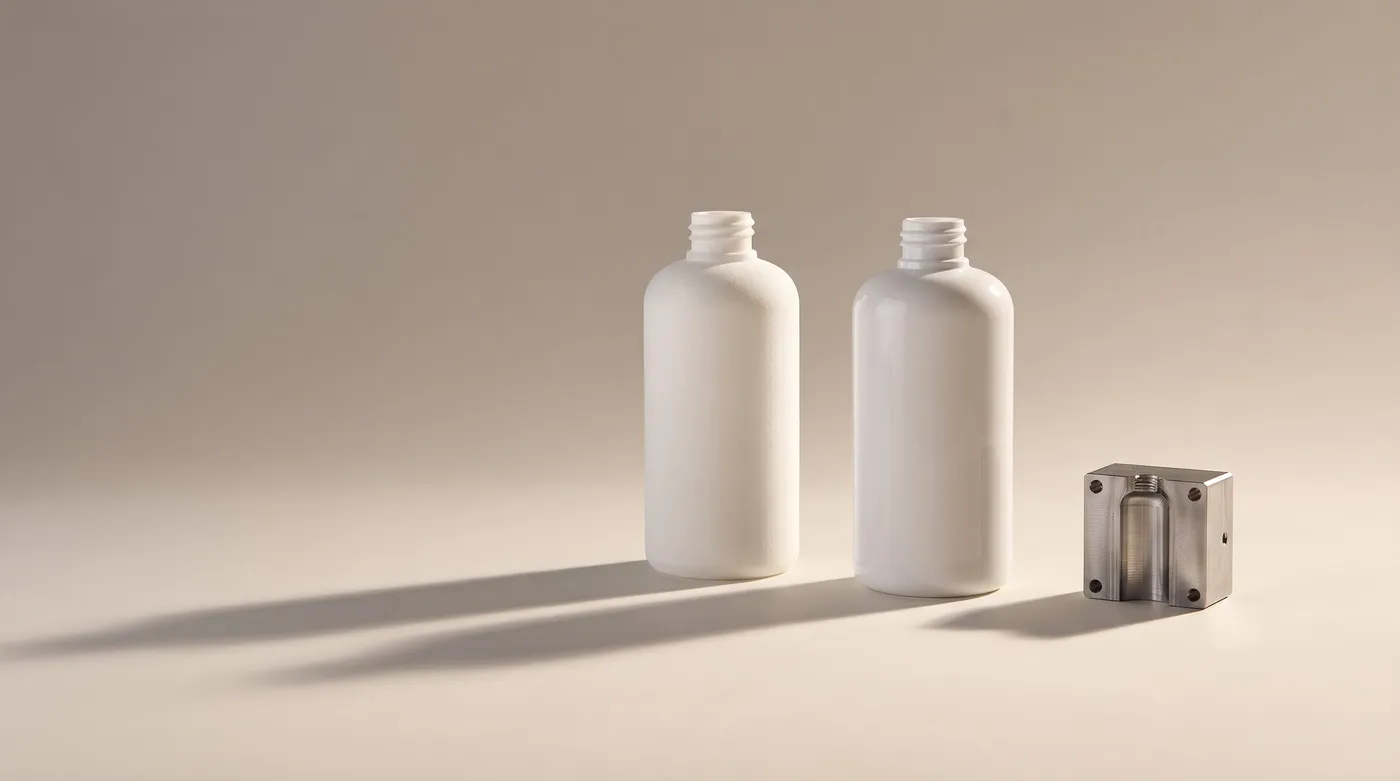
In between come rapid tooling options: an aluminium mould, or printed inserts fitted into a mould base, which will produce only a few dozen to a few hundred parts. These parts are injected in the real material.
Shrinkage can then be measured, screwing torque tested, leak tests run, and sometimes first compatibility studies launched. In the American mould classification, such tools correspond to class 105, that of prototypes.
What no prototype replaces
The production mould remains different: several cavities, optimised cooling, sometimes hot runners, a real cycle rate. The behaviour of a single cavity does not always carry over to sixteen.
For a medicine, the definitive stability studies are done on parts representative of production. The prototype reduces the risk; validating the production mould closes it. See our article from mould to production.
A prototype is not there to prove that the part is good. It is there to find out, while it is still easy, how it is not.
Glossary
- Rapid prototyping
- Quick production of a test part from its design file.
- Rapid tooling
- A simplified mould, often aluminium, for a small trial run.
- Stereolithography
- 3D printing by curing a liquid resin with light.
- Cavity
- The hollow in the mould that gives the part its shape.