What an injection mould costs, and why
A plastic cap costs next to nothing per unit. The mould that makes it is a capital investment. That is no paradox: almost the whole cost of an injection-moulded part is paid in advance, in steel.
By Tecmom editorial team · 3 min read
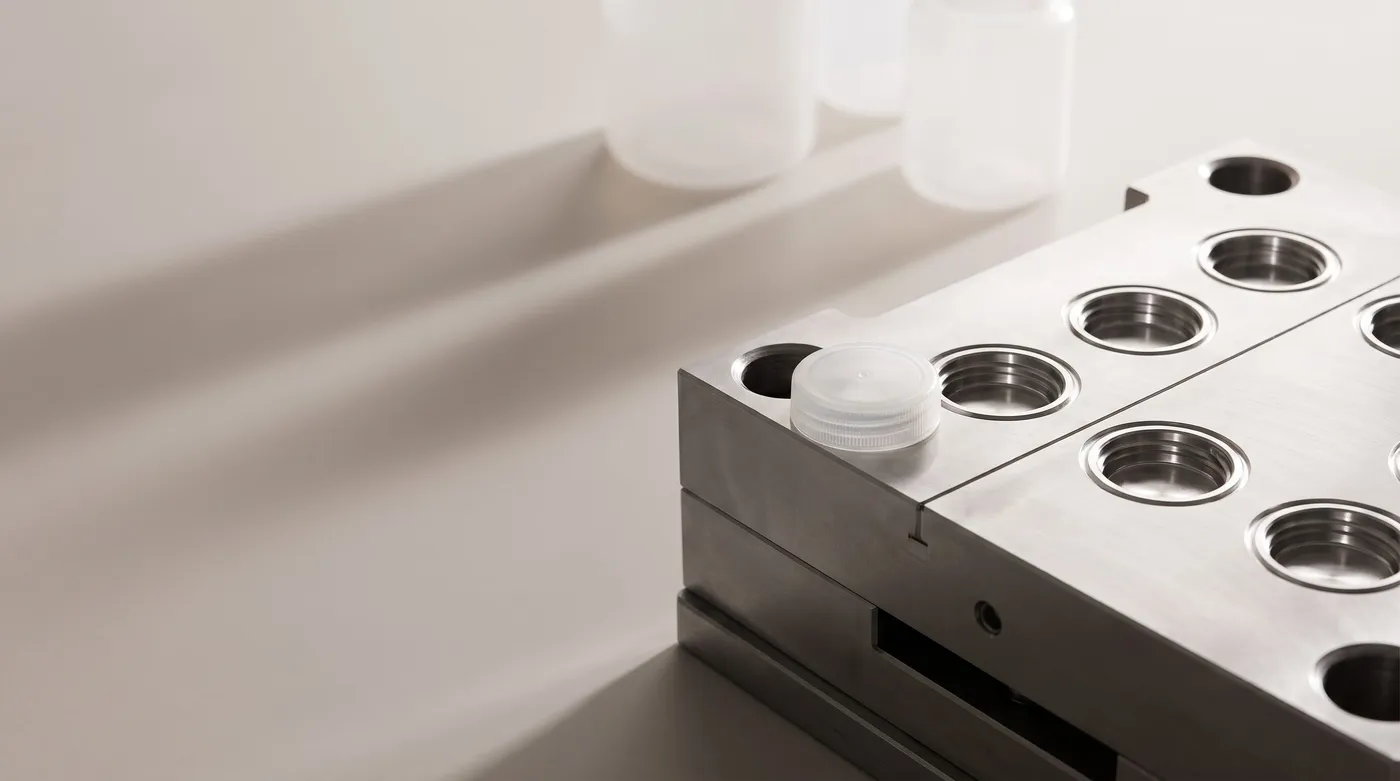
Paying in advance
Injection moulding forces molten material under pressure into a closed mould; the part comes out finished, thread and notches included. The process faithfully reproduces the cavity, down to its finest details. That precision is paid for in the tooling: the mould concentrates most of the cost and the development work, and it takes production runs to pay it off.
Asking "how much does a mould cost" therefore means asking how many parts it must produce, at what precision and at what rate. Here is what makes the answer vary.
The number of cavities
A cavity forms one part per cycle. A single-cavity mould is cheaper to build but makes one cap per cycle; a sixteen-cavity mould makes sixteen. Each extra cavity is more machined steel, and all of them must produce identical parts: balancing the fill becomes a design question in its own right.
The right number of cavities follows from the annual quantity to be produced, not the other way round.
Steel, feed system and movements
Three choices then weigh on the price.
- Steel: a harder or stainless steel resists wear or corrosion better, but costs more and machines more slowly.
- Feed system: with cold runners, the material in the runners is ejected with the part at each cycle; with hot runners, it stays molten in the mould, at the cost of more expensive equipment.
- Movements: a cap threaded on the inside cannot be ejected with a simple push. It has to be unscrewed from the core, or moving parts have to be designed in. Each movement is one more mechanism to design, machine and maintain.
Planned service life
A mould is designed for a number of cycles. The SPI classification, from the US plastics industry association, is often used as a reference: it runs from Class 101, built for more than a million cycles, to Class 105, reserved for prototypes. The longer the target life, the sturdier the steel, the cooling and the guiding must be.
What cannot be fixed later
The last item appears on no quotation: design errors. Material shrinkage on cooling, the parting line, gate locations and the cooling circuit are decided before the first cut. Shrinkage depends on the material, the wall thickness and the moulding conditions. One thread dimension wrongly anticipated, and the seal of the closure is at stake; it can only be fixed by reworking the steel.
That is why Tecmom designs and builds its moulds in-house, in CNC workshops: the company's name, Technologies Moules et Matrices, says as much. See our expertise.
A mould price means nothing on its own. Divided by the number of parts it will produce without drifting, it becomes a cost per cap. That calculation, more than the tooling quotation, should guide the choice.
Glossary
- Cavity
- The hollow in a mould that forms one part per cycle.
- Hot runner
- A system that keeps the material molten up to the cavity entrance, with no sprue to eject.
- Shrinkage
- The reduction in part dimensions during cooling, which the mould must anticipate.
- Parting line
- The surface where the two halves of the mould meet.