Living hinge: how a flip-top cap bends without breaking
A shampoo cap, a box lid, a pill container opened with a thumb: all pivot on a strip of plastic a few tenths of a millimetre thick, moulded in one piece with the rest. That it holds fold after fold, for the whole life of the product, is anything but obvious.
By Tecmom editorial team · 2 min read
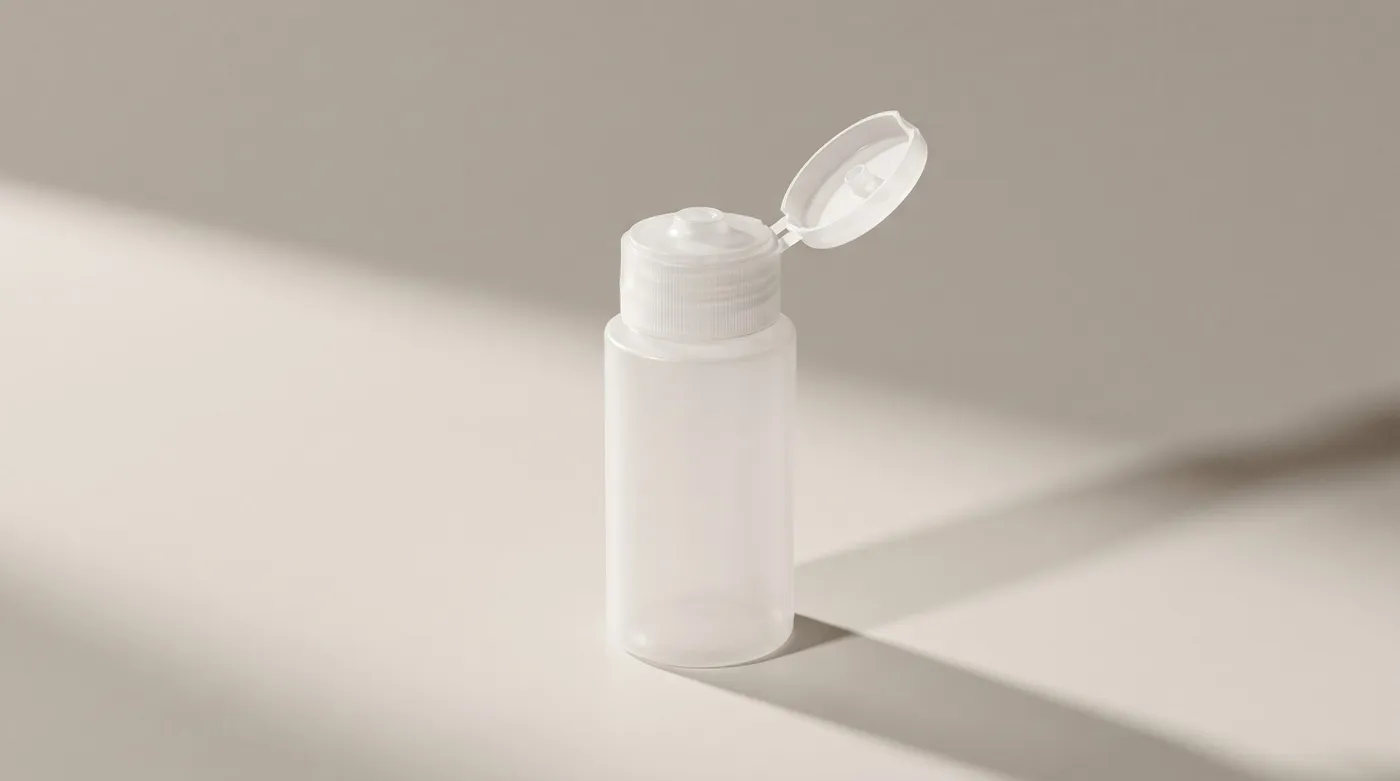
One part, not an assembly
A living hinge is a thin, flexible section that joins two rigid parts made of the same material. On a flip-top cap, it links the body screwed onto the bottle and the lid that folds over it.
Its appeal is industrial: one part, one mould, no pin or axle to assemble. The trade-off is that all the reliability rests on a very thin strip, designed into the steel.
Why polypropylene
Polyethylene and above all polypropylene are considered the best materials for a living hinge, thanks to their excellent fatigue resistance: they can be folded and unfolded a very large number of times without breaking. Stiffer or more brittle plastics are poorly suited.
This is one reason why PP is the material of caps and pill containers; see polypropylene.
It all happens during injection
The hinge's strength depends on how the molecular chains are oriented. When the molten material passes through the thin section, its chains align in the direction of flow. If it crosses the hinge from one side to the other, the chains end up perpendicular to the fold line, and the hinge gains strength.
Hence a mould design rule: place the gate so that the material crosses the hinge in a single front, without forming a weld line there. Some manufacturers also flex the hinge a few times as it leaves the mould, still warm, to extend this orientation.
A geometry of a few tenths
Thickness is counted in tenths of a millimetre: a Protolabs design guide recommends about 0.012 in (0.3 mm). A thicker hinge is not stronger: it bends less easily and its chains orient less.
The hinge is only part of the function. The lid must also close tightly and stay open without falling back; on a medicine cap, it may need to be tamper-evident. All this is decided in the mould, before the first part; see our expertise.
A living hinge is barely visible. Yet it is the part worked at every use, and it is the mould that decides whether it will last.
Glossary
- Living hinge
- A thin, flexible section moulded with the two parts it joins.
- Fatigue resistance
- A material's ability to withstand repeated loading without breaking.
- Gate
- The point where molten material enters the mould cavity.
- Weld line
- The zone where two flow fronts meet, weaker than the rest of the part.