Effervescent tablets: why they travel in a tube
An effervescent tablet is designed to react in water. The trouble is that it also reacts to moisture in the air. All its packaging, from tube to cap, is designed to delay that moment until the glass.
By Tecmom editorial team · 2 min read
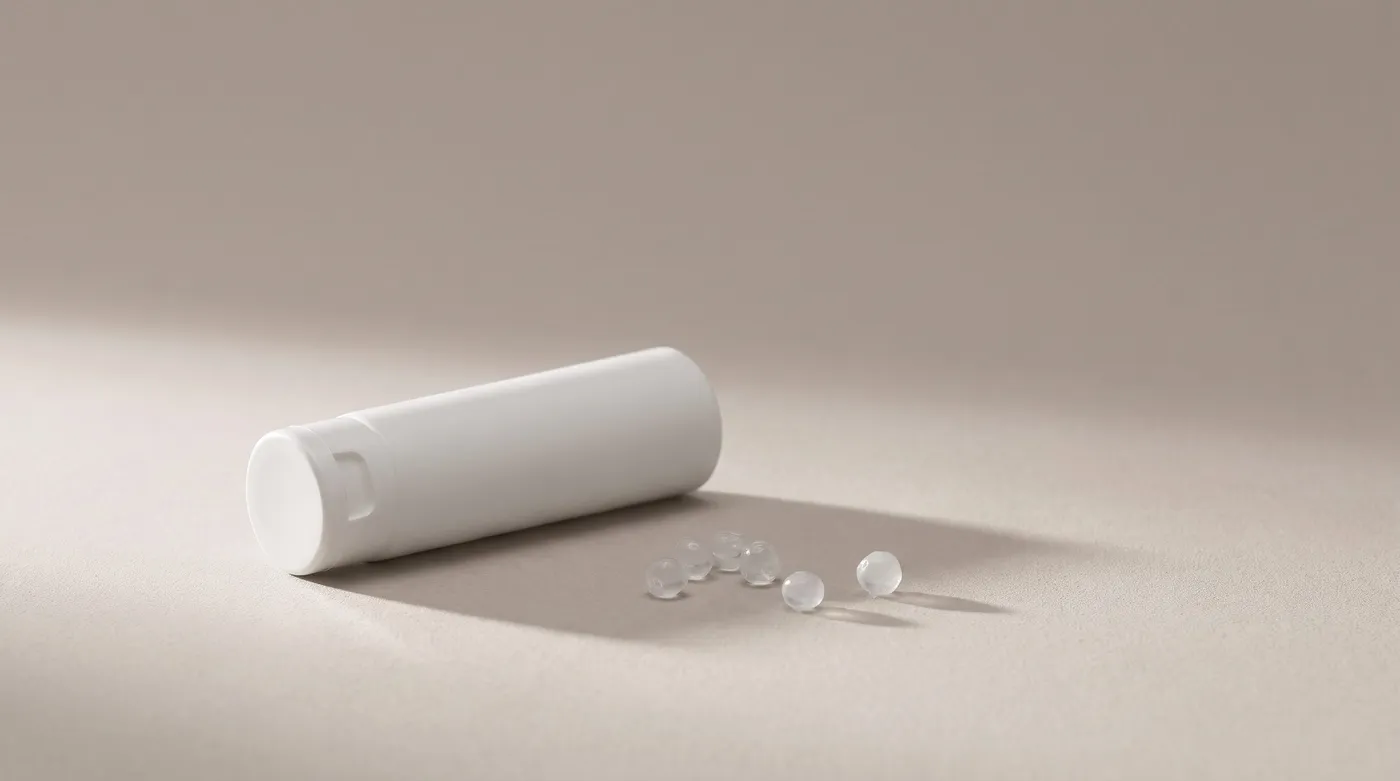
A reaction waiting for water
An effervescent tablet combines an acid, often citric acid, with a carbonate or bicarbonate, such as sodium bicarbonate. In contact with water, the two react and release carbon dioxide: the tablet breaks up and the active ingredient dissolves.
This reaction makes no distinction between the water in the glass and water vapour in the air. Too much humidity can start it early: the tablet swells, crumbles, loses efficacy, and the gas produced can build up pressure in the tube.
Made dry, packed dry
These tablets are made and packed in rooms with very low humidity, often below 25% relative humidity according to packaging specialists. They usually have no coating to protect them: everything rests on the packaging.
Two solutions dominate. The aluminium strip, where each tablet has its own pocket, protects them one by one. The rigid tube, where tablets are stacked, protects them all and closes again after each dose. See our article on blister packs and bottles.
The tube, the cap and the desiccant
The rigid tube is most often polypropylene, injection-moulded in one piece with its base. Its cap holds a desiccant, usually silica gel, which captures the moisture let in at each opening; see our article on silica gel.
Some caps add a spiral, a plastic spring that presses on the stack of tablets. It stops them moving and knocking together during transport, as the tube empties.
What it looks like in a catalogue
Sizing matters: a tube that is too wide lets the tablets move, a desiccant that is too small saturates before the tube is finished. The amount of desiccant is chosen according to the number of openings expected and the conditions of use.
In the Tecmom catalogue, the PP Teff rigid tube is intended for effervescent tablets. It closes with a silica gel desiccant cap, with or without a spiral. Tubes of the same family exist for vitamins and calcium.
An effervescent tablet has only one moment to react: the one when it touches water. Its tube exists so that this moment happens in the right place.
Glossary
- Effervescent tablet
- A tablet that releases carbon dioxide in water and dissolves in it.
- Desiccant
- A substance that absorbs moisture, such as silica gel.
- Spiral
- A plastic spring fixed under the cap that holds the tablets.
- Relative humidity
- The amount of water vapour in the air, relative to the maximum possible at that temperature.