From pellets to bottle: the raw material of plastic packaging
Before it becomes a bottle, a cap or a can, every plastic pack is a sack of small beads. These pellets arrive from the petrochemical plant with their grade, their documents and their requirements, and much is decided before they even enter the machine.
By Tecmom editorial team · 2 min read
A material delivered ready to melt
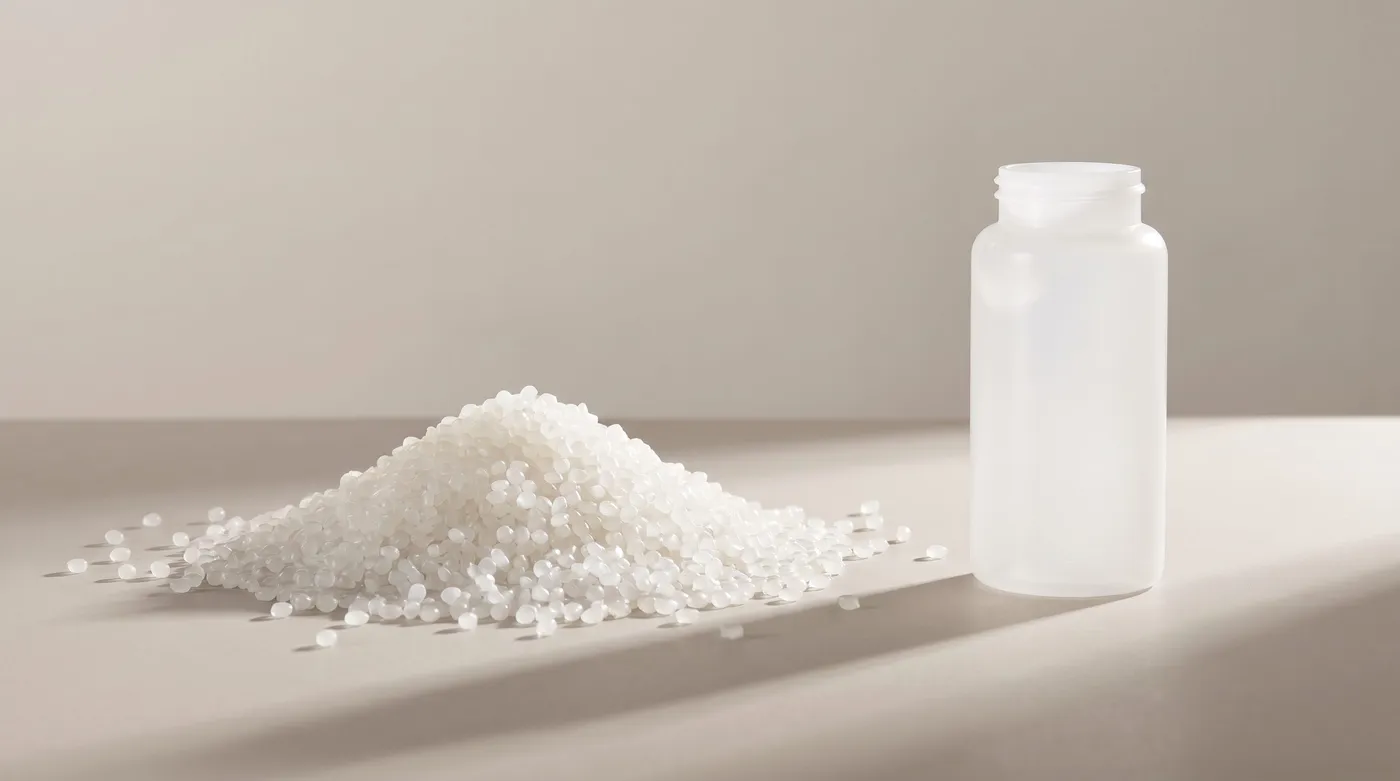
Resin producers deliver polyethylene, polypropylene or PET as pellets a few millimetres across. This form is easy to transport, store and dose: the machine draws them in, melts them, then injects or blows them.
The same polymer comes in many grades. An injection grade flows fast to fill the mould; a blow-moulding grade flows slowly and holds together when molten. This is what the melt flow index measures. The grade is chosen with the part, and once written into a pharmaceutical packaging dossier, it does not change without a procedure.
Every batch has its papers
Each material arrives with its technical data sheet and regulatory declarations: suitability for food contact, compliance with pharmacopoeia monographs for pharmaceutical use. Each batch carries a number and, often, a certificate of analysis.
This material batch number then appears on the certificate of the packaging batch: it is the first link in traceability.
Dry, store, never mix
Some materials absorb moisture from the air. PET is the classic example: processed wet, it degrades as it melts. It is therefore dried before injection; see PET. Polyethylene and polypropylene are far less sensitive.
Storage matters too: closed bags, octabins or silos, protected from dust, clearly labelled. Mixing two grades or two batches by mistake means producing a part whose material is no longer the one declared.
Pellet losses, now regulated
A pellet that falls from a bag or a truck can end up in a river: it is a source of microplastics. The industry launched a voluntary programme, Operation Clean Sweep, aiming for zero loss. The European Union went further with Regulation (EU) 2025/2365 of 12 November 2025.
The text covers operators handling pellets in the Union. Most of its obligations apply from 16 December 2027: risk management plans covering packaging, handling, training and clean-up, and third-party certification above 1,500 tonnes a year.
Good packaging starts with a material that is well chosen, well dried and well kept. The mould never makes up for a badly handled pellet.
Glossary
- Pellet
- A small bead of resin, the form in which plastic material is delivered.
- Grade
- A variant of a polymer suited to a process or use.
- Hygroscopic
- Describes a material that absorbs moisture from the air.
- Octabin
- A large eight-sided cardboard container used to ship pellets.