Squeeze tubes: single-layer or multilayer, a question of barrier
From the outside, nothing tells two cream tubes apart. Cut through their walls: one is made of a single material, the other of several layers, some thinner than a hair, each with its own job. What separates them is what the product can tolerate.
By Tecmom editorial team · 2 min read
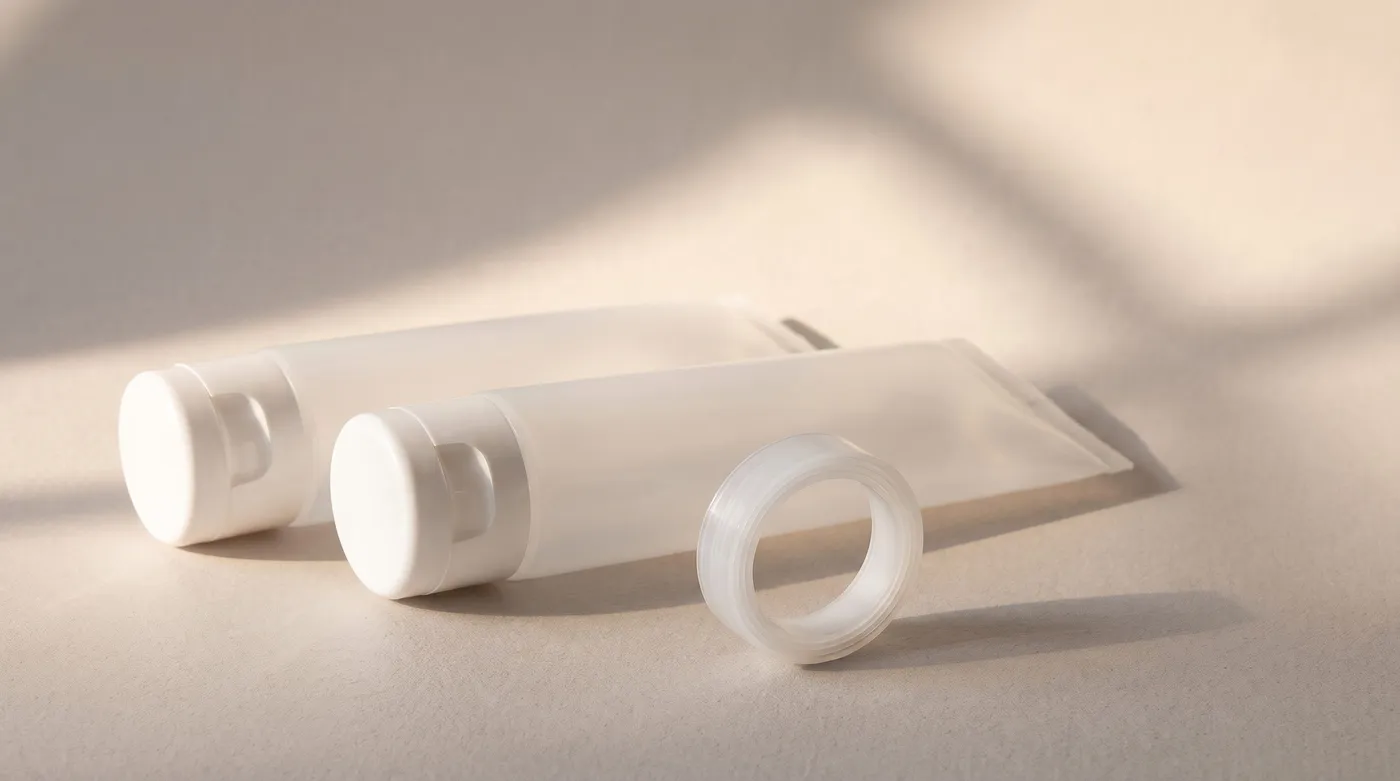
One wall, several jobs
The wall of a squeeze tube has to do a lot at once. Be squeezed without splitting, dozens of times. Tolerate the product it touches without altering it or being altered by it. And, depending on the product, keep out the oxygen or moisture that would degrade it.
A single material can be enough. A single-layer polyethylene tube suits a cream or gel that fears neither oxygen nor loss of fragrance. When the product is more demanding, its functions are split between several layers.
What multilayer extrusion does
In multilayer extrusion, several extruders feed the same die. The materials are stacked within the wall thickness, each bringing what the others lack: mechanical strength for one, a barrier to oxygen or moisture for another, suitability for contact for the inner layer.
A common structure has five: two polyethylene layers, an EVOH barrier layer in the middle, and two thin tie layers that make them stick together. Extrusion International reports that the EVOH layer of a cosmetic tube can be brought down to a few micrometres. This is the process in which the thickness of a single layer decides the product's shelf life.
Coextruded or laminated
There is another family of barrier tubes, laminated tubes, made from a multilayer web supplied on reels. The barrier is either aluminium foil, known as ABL, or a barrier plastic such as EVOH, known as PBL. The choice between coextruded and laminated depends on the barrier required, the decoration wanted and the volumes.
Choosing by product
Three questions decide the wall.
- Does the product fear oxygen? Some cosmetic and pharmaceutical actives oxidise; a barrier layer is required.
- Does it contain volatile compounds? Fragrances and solvents can pass through a single-layer wall or be absorbed by it.
- What does it touch? The inner layer must be compatible with the formula: it is part of a cosmetic's safety assessment, or of a medicine's file in the case of an ointment.
In cosmetics, appearance matters too: colour, feel, decoration. See cosmetic packaging.
In the Tecmom range
Tecmom runs multilayer extrusion, alongside injection moulding and injection blow moulding. See our expertise. The catalogue lists an 80 ml single-layer HDPE tube for cosmetic creams and gels, and flexible tubes from 25 to 50 mm in diameter.
A multilayer tube is not a thicker tube. It is a wall where every micrometre has a function. And it is the product's sensitivity, not habit, that should decide how many layers are needed.
Glossary
- Single-layer
- A wall made of one material.
- Multilayer extrusion
- A process that stacks several materials within the thickness of one wall.
- Barrier
- A wall's ability to slow the passage of oxygen, moisture or aromas.
- Tie layer
- A thin layer that bonds two incompatible materials.