Eye dropper bottle: getting a repeatable drop
Eye drops are dosed by the drop. The drop still has to be the same every time. Its size does not depend on the medicine alone: it is largely decided in the plastic of the bottle and in the geometry of its tip.
By Tecmom editorial team · 3 min read
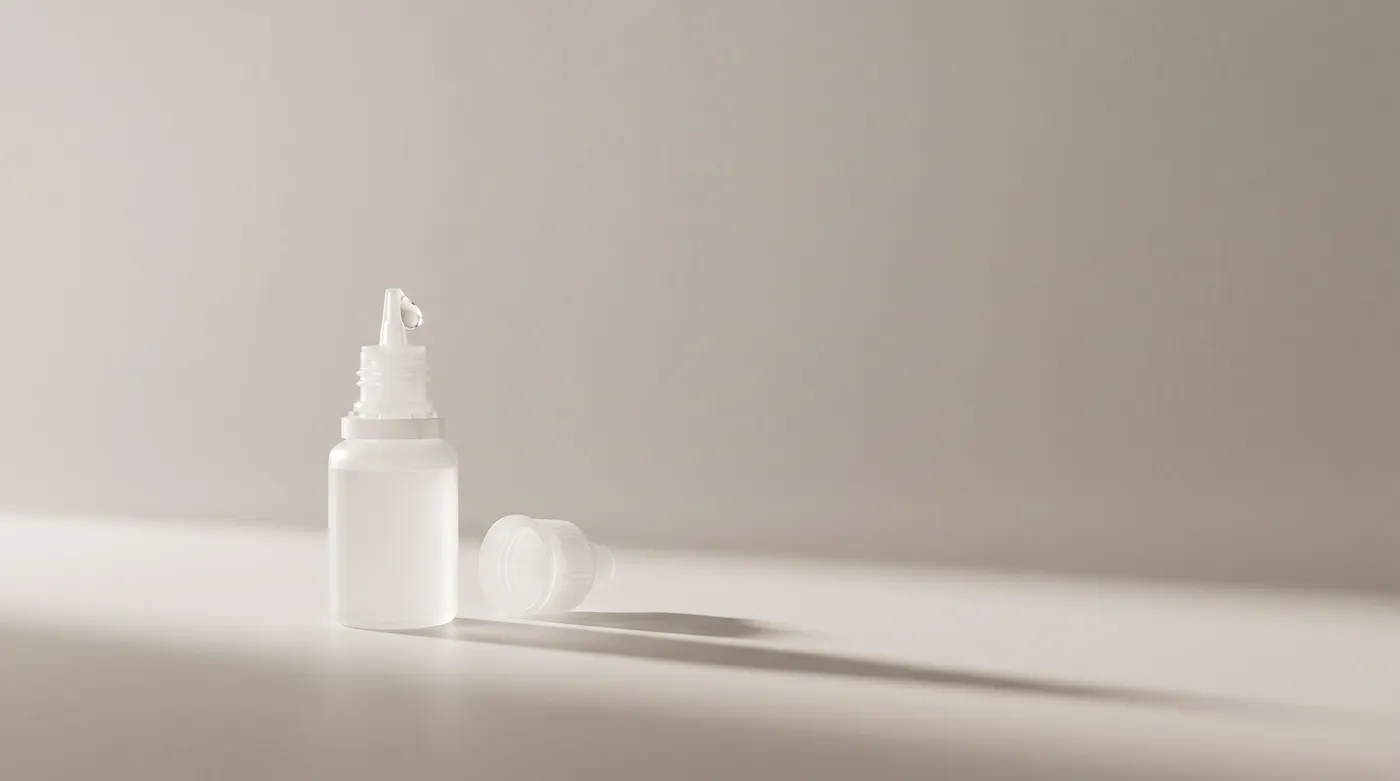
A dose that falls by itself
A dropper bottle has no syringe and no spoon: the dose is the drop. The patient turns the bottle over, squeezes, and a drop forms at the end of the tip until its weight overcomes the tension holding it.
The reference review on the subject, published in 2004 in Survey of Ophthalmology, notes that commercial bottles deliver drops of 25 to 70 microlitres. Its authors recommend, for biopharmaceutical and economic reasons, instilling much smaller volumes, 5 to 15 microlitres: beyond that, the excess overflows and is lost.
Four factors, three of them in the pack
The same review sorts the determinants of drop size:
- tip design: diameter and shape of the end where the drop forms;
- bottle characteristics: the flexibility of its wall, which sets the pressure transmitted;
- solution properties, starting with surface tension;
- the patient's handling: bottle angle and squeezing pressure.
A Brazilian study on artificial tears measured a variation of more than 10% in drop volume from bottle angle alone. A repeatable pack does not remove that factor, but it avoids adding others.
What the pharmacopoeia sets
The European Pharmacopoeia governs eye preparations. Eye drops are sterile. In multidose containers they contain an antimicrobial preservative, unless the preparation itself has adequate antimicrobial properties; without preservative, they come in single-dose units or in a multidose container that prevents contamination after opening.
A multidose eye drop container holds no more than 10 ml, unless justified. The label states the period of use after opening, which does not exceed four weeks, again unless justified. That is as many openings and closings as the bottle must withstand without leaking. See pharmaceutical packaging.
The mould makes the drop
A tip orifice is tiny, and the drop depends on it directly. That kind of detail cannot be reworked after moulding: it comes out of the injection mould at size, or it is wrong. The tooling is what guarantees that a bottle made at the end of a run delivers the same drop as the first.
Sealing is decided at the neck. The thread of the neck finish and the cap's sealing surface must hold through a month of daily use, bottle upside down.
In the Tecmom range
The catalogue includes a 10 ml HDPE dropper bottle with an 18 mm narrow neck finish, for ophthalmic and ENT solutions, a 20 ml bottle with the same finish for drops and low-dose solutions, and a 5 to 10 ml ophthalmic bottle.
Nobody looks at the tip of an eye drop bottle. Yet every morning it decides the dose. A repeatable drop is a tiny orifice, drawn once in steel and repeated identically, bottle after bottle.
Glossary
- Dropper bottle
- A bottle whose tip delivers the liquid drop by drop.
- Dropper tip
- A part fitted to the bottle neck, pierced with the orifice where the drop forms.
- Multidose
- A bottle opened and closed at each use, as opposed to a single-dose unit.
- Surface tension
- The force that holds the drop at the tip until its weight wins.