Cleanroom: what "produced in a controlled environment" means
A particle that falls into an empty bottle will stay there until it reaches the patient. That is the whole point of a controlled environment: not a cleaner workshop for its own sake, but one where contamination is controlled, measured and proven.
By Tecmom editorial team · 2 min read
Why a packaging plant cares
A bottle, pill container or rigid tube intended for a medicine is delivered empty to the laboratory, which fills it. Whatever it holds on arrival, dust, fibre, particle, will end up in the product. For primary packaging, the cleanliness of the production area is therefore not a matter of image: it is a property of the product delivered.
A controlled environment is a production area where particulate contamination, temperature and access are controlled and measured. See quality at Tecmom.
Counting particles
Air cleanliness is measured, and ISO 14644-1 sets its classes by the number of particles per cubic metre of air. For particles of 0.5 micrometres and larger, an ISO Class 8 room allows at most 3,520,000 per cubic metre, an ISO Class 7 room at most 352,000. Each class is ten times stricter than the one before.
The air of an ordinary workshop is far from these values. They are reached with filtered, renewed air kept at a slight overpressure, so that dirty air does not come in when a door opens.
Behaviour matters as much as filters
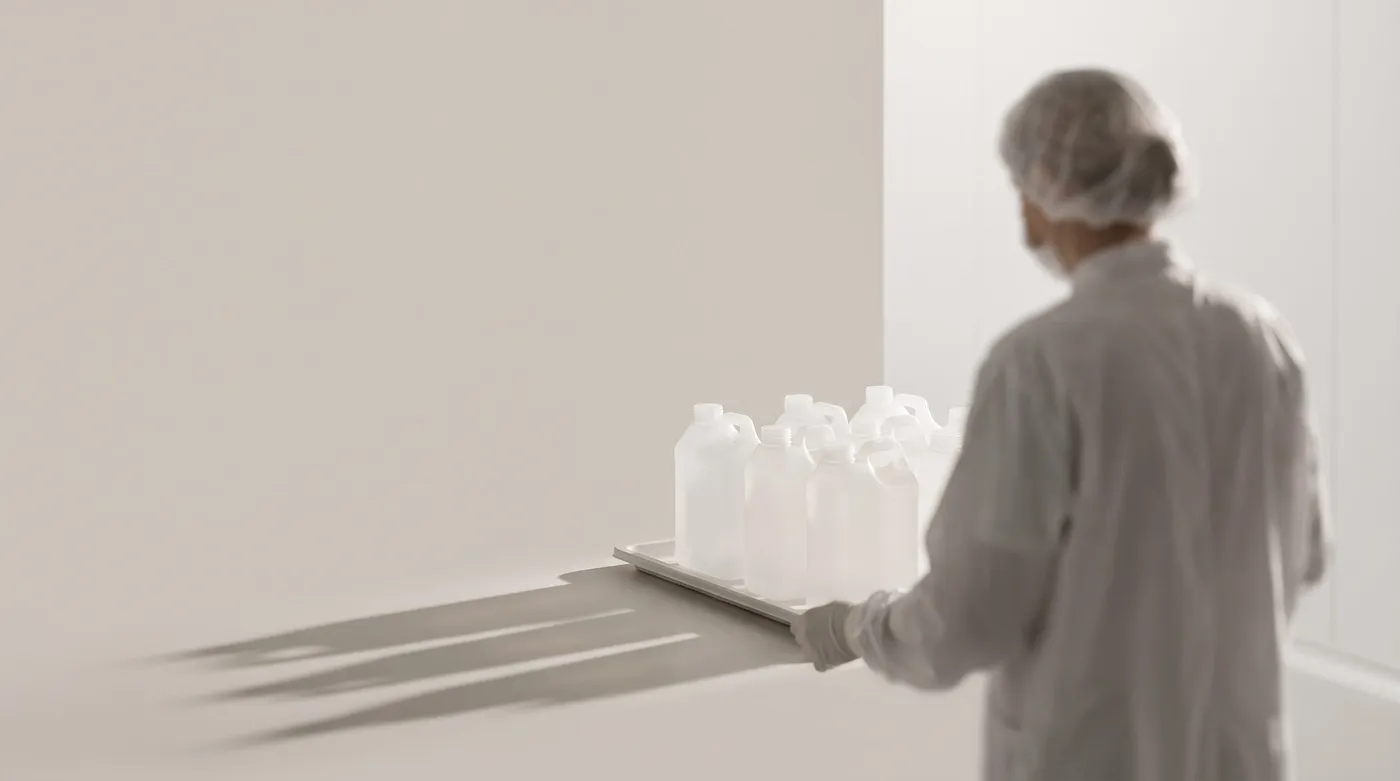
In a cleanroom, human activity is a major source of particles. Hence the rules visitors usually discover: entry through an airlock, dedicated clothing, hair cover, gloves, slow movements, equipment cleaned before it comes in. Cardboard, which sheds fibres, stays outside; parts leave in clean bags or containers.
Monitoring follows: particle counts, temperature and pressure records, cleaning according to written procedures. A cleanroom is not a state; it is a daily discipline.
What ISO 15378 says
ISO 15378, the standard for primary packaging materials for medicinal products, applies Good Manufacturing Practice to their production. It does not set a single cleanliness class: it requires a suitable, controlled work environment, chosen according to risk, with the prevention of contamination and mix-ups. It is up to the manufacturer to justify its choices, and to the auditor to check them. See what the standard requires.
Tecmom is certified to ISO 9001 and ISO 15378 and produces in a controlled environment.
You cannot see a cleanroom at work: you see people in gowns walking slowly. What you cannot see are the particles that are not in the bottle. That is exactly what the laboratory is buying.
Glossary
- Controlled environment
- A production area where particulate contamination, temperature and access are controlled and measured.
- ISO 14644-1
- The standard that classifies air cleanliness by the number of particles per cubic metre.
- Airlock
- A transition space between two zones that limits the entry of contamination.
- GMP
- Good Manufacturing Practice: write down what you do, do what you wrote, and be able to prove it.